Sunday, March 30, 2008

Only the Shadow Knows

Shadowplay
Tad Williams
DAW

As I write this, I’m sitting at the gate in LHR waiting to board a flight. While I haven’t been travelling too much as of late, I am still managing to put in enough time at the airport to get some serious reading done. For this particular trip, I actually broke one of my cardinal rules of travel and brought along a ginormous 600+ pager. Yeah, yeah, -- not exactly a short haul friendly tome. On an overseas flight (where I can, ahem, check luggage), it makes the space argument a little less compelling, and frankly, this one was definitely worth the room in the carry on.

Shadowplay is Williams’ second book of the Shadowmarch trilogy. If you recall, I reviewed the first book for one of my initial entries for this blog (don’t go back and read it – WAY too long). While I really liked the opening effort, I think that the second instalment lived up to (and maybe even exceeded) the standards of the first. From the moment I picked it up, I didn’t really want to do anything but read. So what if I travelled a few thousand miles to go to the office this week? Work schmerk.

Book Two of the series picks up right where the last book left off. Unlike a lot of serialized fiction, Williams makes the assumption that the readers have been following along and very little time is wasted summarizing the plot. As for the content, it’s the usual fantasy fare -- anthropomorphic creatures, battles, magic and death. Really – what’s not to love? Three fellowship rings out of five.

Wednesday, March 26, 2008

Anything But

The Big Sleep
Raymond Chandler
Vintage Crime/Black Lizard

Okay, so I've got to come clean. Deep breath ... I'm addicted to detective novels. There ... I said it and it hardly even hurt. Of course, I'm blaming it all on an evil, yet "well-intentioned" friend. Last summer when I was dying for a good book, Russ recommended Chandler's The Big Sleep. Unfortunately, the local bookstore didn't have it and I picked up The Lady in the Lake instead. I totally loved that novel, but believe it or not, this one was even better.

Like the other Marlowe book, The Big Sleep is set in and around Los Angeles in the late 30s. The cagey and unspeakably sexy hero, Philip Marlowe, has been hired by an aging oil tycoon to find out who has been blackmailing one of his wayward daughters. There are more twists in this plot than a mountain road has curves, and while I will admit to finding it a bit of a stretch at times, the writing was so engaging that I didn't really care. Chandler possesses a grim economy of words that is both disconcerting and delightful. His more than slightly misogynistic descriptions of women are especially wonderful and for those of you who are (un)lucky enough to have me as an IM contact, you might have noticed that you were treated to an entire week of politically incorrect Marlowisms.

Oh yeah ... if you haven't figured it out, the title of this week's entry relates to the title of the book. It was anything but a big sleep --in fact, I couldn't put it down. Four RedBulls out of five.

Saturday, March 08, 2008

Working Girl

The Observations
Jane Harris
Faber and Faber

I have to apologize to my regular readers for not updating the blog the past couple of weeks. There really isn't a good excuse. Admittedly, part of me is still thinking about The Book Thief, but I've also been crazy busy at work, getting frustrated by my diet/workout schedule, looking around for a new place to live, and spending a significant amount of time writing email. I can normally multi-task with the best of them, but really -- I've been pooped.

The other part of the problem was the subject of this week's entry -- Harris' The Observations. I can't think of another way to say it, so I'm just going to be blunt. This book completely sucked. It could be that my expectations were too high. In picking it up off the table (I got it a few weeks ago when I was over in the UK) I was drawn in by the comparisons to characters such as Moll Flanders and Becky Sharp. I loved both of those books and was really looking forward to a similar read. So that was my first mistake.

I might have been able to live with the flat characterizations had the book told a more interesting story. It's been awhile since I've thoroughly savaged a text, but Harris' narrative was entirely predictable. No such thing as subtle foreshadowing or plot twists in this effort. One vituperative Victorian out of five.

Sunday, March 02, 2008

It is certain that stealing nourishes courage, strength, skill, tact ...

The Book Thief
Markus Zusak
Black Swan

I must have been about ten or so when my mother decided I was mature enough to understand, and therefore read, The Diary of Anne Frank. Up to that point, the war hadn't been discussed much in my house. I grew up knowing that both of my grandfathers had "fought for our country", but being a child of the 70s, I didn't really have any context for what that meant. Reading Anne's story completely changed my life. I became obsessed with the narratives of the Second World War and in particular, I developed an unhealthy interest in the Holocaust.

The main character in The Book Thief, Liesel Meminger, reminds me a great deal of Anne Frank. Set in a small town just outside of Munich, the novel tells the story of a little girl who is sent out to live with a working-class foster family just prior to the start of the war. In some ways, the books is a classic bildungsroman as the reader is witness to Liesel's journey from young girl to young adult. In other ways, though, the story is about larger themes -- war, resistance, inequality, literature, love, and kindness. Every page of this novel (curiously narrated by Death) deserves to be read and once you pick it up, you won't be able to put it down. Four stolen books out of five.

Sunday, February 17, 2008

Hardboiled ... and Then Some

The Maltese Falcon
Dashiell Hammett
Vintage Crime/Black Lizard

We met in a an out-of-the-way bar just off O'Farrell and Mason. I was on assignment writing a special for the Examiner, Sam was working a case. He came over to my table, stopped in front of me and said "Sweetheart, can you be a pal and talk to me like we know each other?" I shrugged my acquiescence and gestured toward a chair on the opposite side of the table. Sam quirked a thickish brow and surveyed me top-to-toe with those yellow-grey eyes. He signaled to the barman, sat down next to me and leaned in. "You look like a dame," he said with a languid grin, "Who can appreciate a drink. Tell me your story to help me pass the time." Sigh. If I had only known what I was getting into.

Sam, it seems, did not approach me by chance. I was in San Francisco chasing down leads on a stolen artifact related to the Templars. I didn't know it at the time, but Sam had been engaged to find the same object d'art by one of my paper's chief rivals. All I had was a story at stake -- for Sam, it was decidedly more personal. The night before we met, his business partner had been murdered and it was somehow all tangled up in the missing statue. Sam was charming and sexy, and while I was falling in love, he was pumping me for information. I should have figured him for a private eye the moment he walked in. He had that don't fuck with me, lone-wolf look that I've been attracted to before.

In the end, we both got what we wanted. The statue turned out to be a fake and for the most part, the bad guys got away. After a few days, I said goodbye to San Francisco as I was hot on the trail of another story. As for Sam, well, I have a feeling that I'll be back to visit him someday soon. He was an interesting man and I'm always up for a little murder and mayhem. And oh, just in case you were wondering -- the drink that Sam ordered? It was a Manhattan. Best damn drink I've ever had -- I'd give it five stars out of five.
Something Can Taste Worse than Buckley’s

The Shock Doctrine – The Rise of Disaster Capitalism
Naomi Klein
Random House

If you have been following this blog for even the briefest period, you’ll have noticed that, quite frankly, I read an awful lot of crap. While I don’t believe that you have to read/eat/be good all of the time, I do think that everyone has a social responsibility to try to improve themselves and in doing so, improve the quality of life of those around them. That said, every once in awhile, I try to read a book that I know will be “good for me” even though I might not like it.

Naomi Klein's The Shock Doctrine is a thoroughly researched, thought-provoking look at the rise of free-market fundamentialism of the last half-century and how various governments and regimes (from Pinochet's Chile, to Yeltsin's Russia to Bush's privatized war on Iraq) have followed the principles of shock and awe to re-make their respective economies. Sometimes, as in the case of New Orleans or Sri Lanka, the shock and awe is due to an overwhelming natural disaster that presents a "reconstruction" opportunity too good to be missed. In other cases, like the coup against Allende or the invasion of Iraq, economic shock therapy is directly tied to violence, torture and abuse. Regardless of the source, the disturbing trend in all cases is that the economic makeovers serve only to line the pockets of the already rich. Sure, it might be free market capitalism at its best, but is it moral?

I could go on at length about all the upsetting things that I read in this book. I have to say, though, that it was Klein's examination of present-day war profiteering that bothered me the most. To read the chapters in her book about Rumsfeld, Blackwater, Lockheed Martin, and Halliburton literally made my stomach hurt. So much so, that I wanted to stop reading. Like a good girl, I took my medicine and I'm better off for it. I'd suggest that you take it too. Four and a half cough drops out of five.

Wednesday, February 06, 2008

Roses are Red, Violets are Not ...

The Eaten Heart: Unlikely Tales of Love
Giovanni Boccaccio
Penguin Books

In honour of St. Valentine's Day, I figured I should post an entry about love. Don't laugh -- I know I'm not exactly considered an authority on the subject (can you say disaster with boys?) Thankfully, Boccaccio was an Italian living on the verge of the Renaissance and as such, I'd say that he knew all about the painful, beautiful, exciting, dreadful, angst-ridden, most joyful of all emotions.

The Eaten Heart is a series of tales excerpted from Boccaccio's Decameron. The year is 1348 and ten very witty and charming Florentines flee their plague-filled city and retreat to the country where they tell each other tales to pass the time. Unlike his literary predecessor, Dante, Boccaccio is no moralist and his stories are filled with humour, bawdy language, sex and intrigue. A lot of really good aphorisms have come out of this text, but my favourite has to be, "One woman could exhaust many men, whereas many men can't exhaust one woman." So who cares if it is a little anti-feminist? It's pretty funny and the fact that it said by an old woman encouraging a young wife to cheat on her husband makes me laugh even more. Three point five cupids out of five.

And oh, the title for this week's entry? I'll buy dinner for the person who comes up with the most creative/funniest completion to the poem.

Sunday, February 03, 2008

Off the Grid

The Dark River
John Twelve Hawks
Random House

So, one of the things that I really like about fantasy/science fiction is its ability to provide biting social commentary without being overly didactic. Unfortunately, there was nothing subtle about this novel and Twelve Hawks basically uses a sledgehammer to drive home his message about the dangers of information age.

The Dark River continues the story of Gabriel and Michael, two young men who learn that they have the power to travel across "realities" and take themselves to other dimensions. The brothers are divided -- Michael joins the evil Tabula and uses his new powers to manipulate and control. Gabriel remains on the run, protected by the group of friends that he met in the first novel.

Like most second books in a trilogy, The Dark River is not as compelling as the first. While it is fast paced and moderately interesting, it is more of a transition novel and is (hopefully) setting things up for an action-packed, thought provoking finale. I'll probably wait until the last book comes out in trade paperback before picking it up. I'm not sure that The Dark River was worth the price of the hardcover. Two point five RFID tags out of five.

Monday, January 28, 2008

All Hat and a Bag of Chips

All Hat
Brad Smith
Penguin

A couple of Saturdays ago, I was wandering around the bookstore with some Christmas money burning a hole in my pocket. I had been having a difficult time finding something to read when, all of a sudden, a wobbly old lady lurched into my path. Truth be told, she almost took a header down the Chapters staircase and in my heroic effort to prevent a broken hip, I inadvertently knocked over part of a display. Happily for us both, I caught her in time and after getting a frail hug and a couple of kisses, I went to pick up the books that I had scattered. Once my hand touched Smith's All Hat, I knew it had to be mine. And they say good deeds usually go unrewarded. Hah! ...

All Hat is the story of Ray Dokes, a paroled ex-con who decides to return to the Ontario town of his childhood to re-establish some kind of "normal" life on the outside. His main goal is to stay out of trouble, but that proves difficult when the local bigshot, Sonny Stanton, is buying up all the farmland in the region and has his sights set on the place that just happens to belong to Ray's former girlfriend. Oh, did I mention that Ray went to jail for beating Sonny to a pulp after he found out that Sonny had raped Ray's little sister? Ray, it seems, has a taste for revenge and a plan that is so daring that it just might work. Or land him back in jail. You'll have to read it to find out.

Part Carl Hiaassen and part Alice Munroe, this story has a cast of characters that are at once infinitely zany and infinitely recognizable for those of us who grew up in a small Canadian town. I quite liked this novel and it is probably our first 2008 contender for the DES book of the year. Three sleek geldings out of five.

Monday, January 14, 2008

Withering ... Wuthering ... Whatever

Wuthering Heights
Emily Brontë
Penguin Classics

Hey gang -- so I finished Wuthering Heights on Monday. It is now a week later and I'm still struggling to find something relevant to say about this book. If you haven't read it before, WH is essentially a dark, brooding love story between two wholly unlikeable characters -- Mr. Heathcliff and his beloved, Catherine Earnshaw.

For me, the most fascinating element of this novel is the layers of narration. The story is told to the reader through Mr. Lockwood -- a tenant of Heathcliff's at Thrushcross Grange. He, in turn, is being told the story by Heathcliff's childhood playmate and former housekeeper, Nelly Dean. Other "eyewitness accounts" are shared with reader and it is amazing how Brontë manages to maintain the narrative's vibrancy and impact by essentially telling the tale through a series of "he said, she saids." While I didn't particularly care for any of the characters, I still really enjoyed this novel. Brontë's depiction of love as an all-consuming, soul-destroying force is as beautiful as it is terrifying. WH gets three howling winds across the moors out of five.

Friday, January 04, 2008

Brains ... I Need Brains ...

Crime and Punishment
Fyodor Dostoevsky
Penguin Classics

Never have I purported to be the sharpest tool in the shed, but this is one classic that definitely went over my head. Here's the basic plot: Rodion Romanovich Raskolnikov, a depressed, really bright, but slightly mad former law student commits a random murder at the beginning of the novel. If you can look past the murder, he seems to be a fairly decent guy -- he wants to do right by his family, shares his meager funds with others less "fortunate" than he, and even falls for and is eventually redeemed by his love for Sonya, a young woman who is forced into prostitution to support her parents and siblings.

After the murder-- which happens in the first few chapters -- the rest of the novel deals with the Raskolnikov's inner struggle and how he copes with the psychological ramifications of what he has done. My problem with the book is that I don't get what motivated him to kill the old woman in the first place. I put the question to my friend Victor (an educated man and a lover of Russian literature) and his response was to quote a lyric from Cash's Folsom Prison Blues -- "I shot a man in Reno/Just to watch him die."

Um, okay, but that doesn't really get me any closer to the "why" of it. I'm going to be honest here -- I thought Rodion was a bit of a nihilist. And then I thought he had read too much Nietzsche (only sort of kidding.) And then I wondered if he was a plain ol' sociopath. Jury is still out. I'm meeting Victor for lunch on Sunday. Maybe he can help me make sense of it all. Four greasy kopecks out of five.

Monday, December 31, 2007

And the Winner is ...

I bet you guys thought I forgot all about the Dog-eared Soul's Book of the Year. I held off on announcing the winner as I was a little slow in distributing some of my Christmas gifts and I didn't want to give away the surprise.

The book that moved me most in the past year was unquestionably Tahar Ben Jelloun's This Blinding Absence of Light. I believe that it is possible to be fundamentally changed by what you read and this book made me stop and take a look at my life from a different perspective. It was a tough choice for a couple of reasons. I'm not sure that all my friends are going to like it. While it ultimately delivers a message of hope and strength, there's also a lot of despair and, well, madness, in this novel. It's not a fun read and I think you have to be in the right frame of mind to engage with the text.

I also considered not selecting it because it is, almost, non-fiction. What do I mean "almost, non-fiction?" Well, I don't know. Is it a memoir? I hope not -- I've categorically stated that I'm not a fan of the memoir. Is it a fictionalized account of true events? Maybe. Does it make its message any less powerful if all of the elements didn't really happen? Again, I don't think so, but I'm not totally sure. I say -- pick it up, read it, and judge for yourself. And if you have any thoughts on the matter, please share.

Best to all for 2008. I wish you health, laughter, and a soul that dances on the wind.
Happy Friggin' New Year

Blood Brothers
Nora Roberts
Jove

Yes, I am pathetic and totally willing to admit it. Here it is, New Year's Eve, and I'm at home reading and working on my blog. For those of you that know me well, this will not come as much of a surprise. You see, I definitely have a thing against New Year.

As a really little kid, I actually loved it. We used to go to this house party at a friend's place in the country and while my parents never let me stay up until midnight, they did let me eat chips, inhale candy, and drink pop. Big night when I got to do all that and had bedtime extended to 9:30 pm.

It wasn't really until my teenage years that the "problems" began. 1985 saw me ringing in the New Year with a cast on my arm and bruises all over my body. My Aunt Jack and I had been in a head-on collision earlier in the afternoon. We were going to Kitchener to see a Nylons concert, got caught in some slush and then whammo, straight into on-coming traffic.

The next year, I thought I'd take it easy and invite Jennie Beaton over for a quiet night of movies and gossip. Well, quiet until Jennie raided the liquor cabinet and we both did our first drunk-and-dials. To this day I'm pretty sure my parents believed that we had a terrible case of the flu. I'm also pretty sure that I just wanted to die.

In my early twenties, I usually spent New Year's Eve with my boyfriend and his rugby buddies. I was the only girlfriend in the group who was from "away" and as the lone import, the girls didn't go out of their way to make me feel terribly welcome. I'd hang with the guys and flirt until they got too drunk and then hie myself off to bed.

Then there was the time that I broke out in hives when I belatedly realized that I was allergic to the echinacea I was taking to ward off a winter cold. I had hives where, well, you'd think a girl couldn't get hives. My date for the evening thought I was making it all up and never spoke to me again. Sigh. He was hot and the evening could have been promising. Wasn't meant to be, I suppose.

The next year things were looking up and I found myself celebrating on a beach in Curacao with my then boyfriend and his best friend. Sounds ideal, right? Well, imagine being on a holiday when both the girlfriend and the best friend are in love with the boyfriend. That was the final straw and from then on, I decided to celebrate New Year on my own by doing something that I love. Sometimes I have a movie fest (last year I watched all six episodes of Star Wars back-to-back,) sometimes I fast and indulge in girlie stuff like pedicures, getting my hair done, doing makeup, and sometimes, like this year, I go on a romance binge and read all sorts of trashy books.

Blood Brothers, the most recent offering from Nora Roberts, definitely qualifies as trash. The basic premise is that three small town boys go to the local haunted wood to celebrate their birthday (they were all born on the same day at the same time.) While there, they swear an oath of loyalty, and in binding it with their blood, unleash a demon into the world. Flash forward 21 years -- the same boys (now men) need to figure out how to stop the demon. Enter Quinn, a writer who decides to come to the town to do some research for her next book. She's lovely, curvy, and somehow connected to the strange goings-on. Of course, she just happens to fall in love with one of the boys turned men. I have to say, the plot is a tad more complicated than the average Harlequin, and the mix of fantasy and romance has caught my interest. I'll probably stick around for the second and third installments. Two screaming demons out of five.
'Tis but a Scratch!

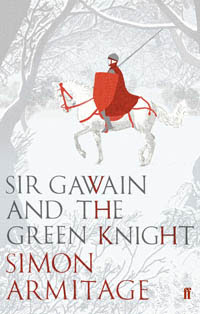
Sir Gawain and the Green Knight
Simon Armitage
Faber and Faber

When I was an undergrad, my worst mark ever was the B+ I received in Middle English from Dr. Weldon. While I hated the professor and his pedantic approach to the texts, I loved the course material and would spend hours reading off the syllabus. I have to admit to not being a huge fan of poetry, but there is just something about verse from the Middle Ages that captures my imagination.

Sir Gawain and the Green Knight was written around 1400. Not a lot is known about the poet and the poem itself is noteworthy in that it draws on the Old English tradition of alliteration. For those of you, um, unpoetical types, alliteration is the repetition of a particular consonant sound or leading vowel in a phrase. It sounds easy, I know, but to do it in such a way that it adds to rather than distracts from a text is quite a talent -- and the Gawain poet does it with such style.

This particular edition of the poem is a new translation by Simon Armitage. He maintains the alliteration and in my opinion, does a fantastic job with the verse. The plot is pretty simple -- a bunch of knights are hanging out with Arthur and Guinevere over the Christmas break. Suddenly, the door to the hall bursts open and in tromps a very large man all dressed in green. He issues a challenge and invites one of Arthur's company to fell him with a blow -- the caveat being that should the Green Knight live, the knight must seek him out a year hence and agree to the same terms. Gawain takes up the challenge, fails to kill the green knight (who, in fact, picks up his severed head, tucks it under his arm and rides off) and then, a year later, sets out on his own quest. Talk about a party trick! Armitage's translation gets 5 green girdles out of 5.

Wednesday, December 19, 2007

And the Nominees Are ...

So, it's not like the D-E-S has been deluged with requests or anything, but a few of you written to ask about this year's candidates for best book. It's a tough one ... I ended up reading a lot of really good stuff this year and picking just one is going to take some serious thought.

In fact, it might be easier to come up with some exclusion criteria. Romances are not eligible by virtue of the fact that they are absolute crap and essentially the same book regardless of sub-genre, historical period, or setting.

Non-fiction books, while impressive and impactful, are not eligible. Maybe someday I will get motivated enough to set up another category for a non-fiction winner. But not today.

Any post where I made mention of Bruce Campbell -- those books aren't eligible either. Don't get me wrong, I love Bruce. But he's not serious and high-minded -- not at all what we are looking for in a D-E-S book of the year.

So, after all that, the nominees are:

Three Day Road Joseph Boyden
Arthur & George Julian Barnes
The Road Cormac McCarthy
This Blinding Absence of Light Tahar Ben Jelloun
The Traveler John Twelve Hawks

Tuesday, December 18, 2007

Jay Silverheels ... what were you thinking?

The Lone Ranger and Tonto Fistfight in Heaven
Sherman Alexie
Grove Press

I read somewhere that Sherman Alexie is better known for his poetry than for his prose. He must be a helluva poet, because this book of short stories is simply amazing.

The Lone Ranger and Tonto Fistfight in Heaven is a series of vignettes set in a Spokane reservation in Washington State. The stories feature a variety of characters across a generation and all of the tales in some way deal with what it means to be Native in a post-modern, white person's world. Alexie's depiction of life on the reservation brought back some good memories for me -- going to powwows on the Chippewa First Nations' reserve near my cottage and marvelling at the energy, inclusivity, power and grace of the dancers.

It also brought back some not-so-good memories for me and frankly, a great deal of guilt and frustration. No matter what you might hear, Canada has not treated its First Nations with respect. While we didn't commit the same level of genocide as our neighbours to the south (let's not forget that we did manage to wipe out an entire people -- Newfoundland's Beothuk,) the country still has a lot of reparations, reconciliations, and apologies to be made.

But I digress ... I really liked this book because even though I'm not native, I could still relate to Alexie's characters and their flaws. The poetic, almost magic-realist feel to the work made for a beautiful, but sometimes elusive read. Four laughing coyotes out of five.

Tuesday, December 11, 2007

Someone's Gotta Do it ...
A Dirty Job
Harper Collins

Holy cow! It has been exactly a month since I last posted anything on this blog. Instead of providing a laundry list of excuses as to why I haven't been reading/writing, I'm just going to hang my head in shame and get on with today's entry.

A few years ago, I introduced a few of you to Lamb -- The Gospel According to Biff, Christ's Childhood Pal. It was easily the funniest book that I had read in the last decade and it became the then equivalent of the D-E-S Book of the Year. Because I had enjoyed it so much, I was reluctant to read anything else by the author. Why muck with perfection? (C'mon, you had to expect at least one Jesus pun.) Quite recently, one of my good friends bought me a copy of A Dirty Job and I thought it would be churlish of me to leave it unread. Who wants to be a churl?

I can't believe I'm typing this, but A Dirty Job is almost as funny as Lamb. Set in present day San Francisco, the novel tells the story of Charlie Asher -- a slightly neurotic owner of a Bay area secondhand shop. At the beginning of the story, Asher's wife dies giving birth to their daughter Sophie. As Charlie struggles to cope with his grief and get used to the demands of a new baby, he learns that he has inherited some disturbing new responsibilities. You see, Charlie wakes up one day to realize that he's become Death -- or at least one's of death's minions (Charlie's not the sharpest knife in the drawer.) The chaos that ensues when Charlie tries to reject his new role is mordantly funny. A Dirty Job gets four scythes out of five.

Sunday, November 11, 2007

It's All About the Hair

Blink
Back Bay Books

It has been awhile since I've reviewed any non-fiction on this blog and I'm finding it rather difficult to get this entry going. To paraphrase Malcolm Gladwell, Blink is an adventure story that explores the human ability to make judgements, draw conclusions, and rapidly understand situations all in about the same time as it takes you to bat your eyelashes.

Part psychology text, part sociological tract, Gladwell's work articulates the theory of rapid cognition -- that is, how the mind processes information without really "thinking" about it. During this journey, he asks his readers to consider some fundamental questions that could and probably should inform our own world views. What would happen if we took our instincts seriously? How would our world change if we, as Gladwell suggest, stopped looking at the horizon with our binoculars and focused our microscopes on our own decision making processes? If you are interested in a plausible, reasonable and well written response to either of those questions, then Blink is a book for you.

Oh, and just so you know, I think MG has replaced Bruce Campbell as my new pseudo-celebrity fixation. He's got a lot going for him -- he writes for The New Yorker, he's Canadian, and he's even been on Oprah. Impressive. Blink gets four rapid eye movements out of five.

Sunday, October 28, 2007

UberNerds Untie! Uh, ... I mean, Unite!
Starter for 10
David Nicholls
Villard

So, it's been awhile since I admitted to anything completely ridiculous on this blog. You know that I have naughty thoughts about Bruce Campbell and yes, I'm still watching NASCAR even though Junior is out of the Chase (I have some thoughts about him too!) Are you ready for something new? Well, when I was in high school, I participated in what was, at the time, the most socially suicidal of teen activities. That's right geeks, I was on my school's Reach for the Top team. And I loved EVERY minute of it.

I'd like to think that I only qualified for semi-geekdom. I mean, unlike a couple of my teammates, I could not quote at random from either Fawlty Towers or Python's Meaning of Life. Like the hero from Starter for 10 (who played on his university's equivalent of RFTT) I was a voracious reader, I flirted with leftist philosophies and I went to school hoping to escape the circumstances of life in a small town.

I quite enjoyed this novel and it a lot of ways, the narrative reminded me a great deal of Nick Hornby's writing. The characters were well drawn and in spots, the story was so achingly real that it was hard to read. My only criticism of the book was that it read more like a screenplay, in parts, than an actual novel. Three challenging trivia questions out of five.

Wednesday, October 17, 2007

Only This and Nothing More

The Pale Blue Eye
Louis Bayard
Harper Perennial

Once upon a midnight dreary, while I pondered weak and weary over many a quaint and curious volume of forgotten lore (back issues of The Economist do count as quaint and curious, right?), while I nodded, nearly napping, suddenly there came a tapping (as of some one gently rapping, rapping at my condo door.) "Tis some visitor," I muttered, "tapping at my condo door. Only this and nothing more."

Ah, distinctly I remember, it was in the warm September and ... okay ... enough. I don't think I can keep this up for the whole entry. If you haven't figured it out from the borrowed verse, this week's novel, The Pale Blue Eye, features a very young, and very melancholic Edgar Allen Poe as one of the main characters. Poe has been enlisted by the protagonist -- a wily, but retired, New York City constable -- to help investigate a series of gruesome murders at the West Point Military Academy. Like all great historical whodunits, The Pale Blue Eye if full of mayhem, murk, and melodrama, and Bayard skillfully keeps his readers guessing until the very end.

I have to be honest -- I didn't have a lot of expectations going into this book. Poe is such a huge figure in the American literary landscape/collective imagination that I was quite apprehensive as to how his character would be drawn. Would Poe be just another gimmick/tool to sell more books? It turns out that I needn't have worried. Bayard masterfully uses Poe's own themes, tropes and tone to somehow channel the spirit of the long-dead poet. Four shadowy ravens out of five.