Showing posts with label toronto. Show all posts

Wednesday, August 13, 2008

Not so Beautiful Music
Music of the Primes
Marcus du Sautoy
Harper Collins


So, I think it is time for another heartfelt admission from the D-E-S. As much as it pains me to say it, I can be a terrible procrastinator. I know that some of you reading this are snorting in disbelief, but it's true. Very occasionally, I put things off until they pile up and loom over me like a darkling cloud. Lately, my procrastination has involved two things -- getting myself sorted out for my upcoming move and sitting down to write the blog entry related to Music of the Primes. My move date is, gulp, Wednesday, so I had to get my asterisk in gear today to finalize the logistics. Since I had some time to spare, I figured I should get this task over with as well. Here goes nothing ...

The Music of the Primes is a book about math. More specifically, it explores the magic of prime numbers and in particular, takes a good look at the Riemann Hypothesis -- one of mathematics most famous, and still unsolved, hypotheses. If I were to pick a single word to describe this book, however, it would be "dissonant". The parts of the work dealing specifically with prime number and number theory were, to a lay person, very engaging. The author also attempts to provide a brief overview of the history of mathematics and here is where the book, for me, starts to fall apart and loses my interest. Some of my friends absolutely raved about this text and maybe, just maybe, my expectations were just a little too high. Two whole numbers (or is that integers?) out of five.

Monday, August 11, 2008

Um, Neil Diamond?

Forever in Blue -- The Fourth Summer of the Sisterhood
Ann Brashares
Delacorte Press

So, I was sitting at my desk looking up quotes about autumn for this entry (don't ask) when it hit me. Forever in Blue. Travelling Pants. Forever in Blue Jeans. Neil Diamond. Of course! The author was making an oblique reference to the 70s song lyrics that provided her with the inspiration to come up with the Travelling Pants idea in the first place. Um ... yeah. I think I've been watching too many Gilmore Girls episodes lately. Call me Kirk.

Forever in Blue is the conclusion to the four book Sisterhood of the Travelling Pants series. The girls have made it through their first year of college and instead of spending the summer together, each of them heads off in separate directions in search of themselves. The pants (a pair of jeans that impossibly fits all four of the girls distinct figures) are a talisman of sorts that get passed from girl to girl and make good things happen. This year, the pants are stolen and the girls head to Greece in search of their magic. Well, they don't find the pants, but they do reconnect with each other in a way.

On it's own, this book wasn't very good. It was trite, predictable, and the characters, while becoming slightly more self-aware, didn't really grow. Read in conjunction with the other three novels in the series, however, Forever in Blue ties up some loose ends and satisfies my expectations in terms of where the larger narrative was going. One pair of cutoffs out of five.

Wednesday, July 30, 2008

Ollie Ollie Oxen Free!

Hide and Seek
Ian Rankin
Orion Fiction

My new boyfriend is such a complicated guy. I'll be honest -- the emotional (okay, mushy) part of me thinks that we're soulmates. He listens to Radio Three, he's got books strewn all over his apartment, and his commitment issues make Mt. Kilimanjaro look like a drumlin. Curiously, those are all traits that appeal greatly to this thirty-something girl.

The logical part of my brain whispers something different. It says "careful there, poptart. He's a cop. Worse -- he's a homicide detective. Can you really handle the secrets, odd hours, and sketchy people?" I'll give you an example. The other night, John had invited me over to, uh, hang out and there was a knock at his door. It was a girl from one of the cases he's been working on. Apparently, one of her junkie friends overdosed recently and both he (the deceased,) and now she, thinks he was murdered. Of course, John invited her in, gave her a meal (accompanied by some of the wine I had just bought) and offered her the couch to crash. The next morning, I overheard him on the phone with one of his work-colleagues and they think there might be some kind of satantic/ritual angle to the whole thing. It gives me the shudders just thinking about it.

So, I'm not really sure that Mr. Rebus is the guy for me. Maybe I should just break up with him and get it over with. Sigh. I don't know -- there are parts of him that I think I could get to like. A lot. And then there are those other bits (did I mention the drinking?) that make me think he's just Mr. Right Now. If you were to ask me to rate my chances of staying with him, I'd say that it's about 50/50 -- a two and a half out of five, if you will. I'll keep you posted and let you know how it works out.


Sunday, July 20, 2008

Ran Away and Joined the Circus

Water for Elephants
Sara Gruen
Algonquin Books

Last weekend, when I was hanging in the MoFo (aka Mount Forest, Ontario, population 5121), I decided to wander over to my aunt's place to sit on her front porch, drink one or two of her beers, and read my book. As I was heading up the street, I found that I couldn't resist temptation and I engaged in the dreaded "walk and read." One stumble, a narrow miss with a failed poop n' scoop, and a couple of amused pedestrians later, I finally made it to my destination. I couldn't help myself ... Water for Elephants was just too good to put down!

Set sometime during the Depression, the novel opens with Jacob Jankowski just learning that his parents have been killed in an automobile accident. Despairing of the knowledge that he literally has nothing to go home to, Jacob walks out of his finals at Cornell and hops a train heading west. Much to his surprise, he finds out that he has jumped smack into the middle of a circus troupe -- the Benzini Brothers Most Spectacular Show on Earth.

This story is very compelling and engages the reader on a number of fronts. For the romantic souls in the crowd, there's a love triangle that involves Jacob, the beautiful Marlena and her "paragon schnitzophonic" husband, August. For the history buff, the story is replete with detail regarding the American circus trains, the state of prohibition, and the speak-easy subculture of the 30s. And finally, for the animal lovers out there, one of the central characters in the novel is Rosie, the Polish-speaking elephant who becomes the star of the show. I couldn't put this book down and I'll bet that you won't be able to either. I'm confident that it will end up on the D-E-S selection list for Book of the Year. Water for Elephants gets four side-show attractions out of five.

Tuesday, July 01, 2008

More Grit Lit


Troy -- Fall of Kings
David and Stella Gemmell
Transworld

I have to admit that I started this book with some trepidation. As documented somewhere else on this blog (oh, if only I could figure out how to link to previous posts!), I very much enjoyed the first two installments of Gemmell's series. To recap briefly, the author takes familiar characters from Greek mythology and mashes up heroes, gods and events to create a fabulous retelling of the Trojan War.

Sadly, Gemmell passed away before he could complete the last book in the trilogy and I was more than a little worried that his principal researcher and wife, Stella, wouldn't be up to the task. Boy ... was I wrong! In my opinion, Fall of Kings was even better than Shield of Thunder. There was still enough testosterone in the writing to make the book have that gritty appeal (hell -- my dad read this book!) and the story was jammed full of admirable men and dastardly villains.

I could probably go on about this book for quite some time. But I won't. I will, however, issue a word of caution. If you read this series (and I highly recommend that you do), don't break out your Bulfinch. The Gemmells definitely took some huge liberties with the traditional Greek stories and mythology purists might actually be horrified. No matter. Fall of Kings was fast- paced, engaging, and even a little suspenseful. No mean feat when the reader already knows/anticipates how it's going to end. Three winged chariots out of five.

Sunday, June 08, 2008

Mystery Man

Knots & Crosses
Ian Rankin
Orion Books

When I started this blog, one of my primary objectives was to read outside of my comfort zone. Up until a couple of years ago, I wasn't an adventurous reader. Sure -- I owned all sorts of works that you'd find on a grad school syllabus, but aside from the occasional romance, there was nothing on my shelves that remotely resembled "popular" fiction. In fact, you could say that I was a classic EMBS -- English Major Book Snob. Happily, I'm recovering now, but only because you guys (my friends and some loyal blog readers) have taken me beyond the "fiction" section of the bookstore and encouraged me to read other things.

Knots & Crosses, for example, was recommended to me by my BFF Pete. He's been reading Rankin for quite some time and noted two things that have struck him in particular about the series. The first is that the main character, Detective Sergeant John Rebus is a rumpled, imperfect, complicated, yet wholly likeable guy. Peter actually described him as a "good" man and that's not a term that he uses lightly -- even when talking about a fictional character. The other point of interest is that when you start reading the series from the beginning (Knots & Crosses is set in 1985), Rebus exists in a policing world that is essentially still pre-technology. Curiously, the lack of "modernity" didn't seem to date the story in any way and it was that, more than anything else, that sucked me in. So much so, that I was off to the bookstore this afternoon to buy book number two.

I think Rebus and I are going to become friends before all of this is over. I certainly need someone that I can count on in times of trouble and he seems like just the man to fit the bill. Three point five good guys out of five.

Sunday, May 11, 2008

I'm 2 Old 4 this Shiz

Londonstani
Gautam Malkani
Harper Collins

When I was growing up, I lived in a small town that wasn't exactly what you'd consider ethnically diverse. While we were less than an hour from the city, you could count the number of non-white families on one hand. One of those families, the Fleckers, lived across the street and I spent a tonne of time hanging out in their home. Mr. Flecker was brilliant, a bit eccentric, and always laughing. Mrs. Flecker, by far the best hugger and most gentle spirit on the block, was a schoolteacher and activist. I loved discovering her latest cause via the articles that she'd cut from the paper and post on her fridge. I guess on some level I knew that they weren't "like me", but they were part of the fabric of my youth and and I loved them.

One day, on a visit home from grad school, I pulled into the driveway and waved at Mr. Flecker who was out watering his plants. It was like I was suddenly struck by lightening. I rushed into the house and in an astonished voice cried "OH MY GOD. Mr. Flecker is Indian!" My mother just looked at me and calmly said "Yes, honey, he is. What did you think?" I have to say, that until that precise moment, I had never given it a thought. Up until that morning, he was just Mr. Flecker -- the nice man who used to rummage in his desk to give me a present whenever I wandered over. What had changed in me that I suddenly noticed that he was brown? I'm still searching for the answer to that question and quite honestly, it was a defining moment in my life.

Gautam Malkani's novel, Londonstani, also poses some questions about culture, class, community, family and relationships. Written in an idiom/language that is as complex as the characters are stereotypes, the book explores the Indian "sub culture" in contemporary London and in particular, in the mostly Indian borough of Hounslow. If you can handle the combination of txt msg, Panjabi, and gangsta-speak, this book is well worth reading. The ideas that it posits about cultural (mis)appropriation and Bling Bling economics are particularly interesting. And, bruv, b on da look out for da killa twist at de end, in't. Three point five bhangra beats out of five.

Saturday, April 26, 2008

Uh, Please Stand By

To Wed a Wicked Prince
Jane Feather
Simon & Schuster

Now, before you all castigate me for reading yet another crappy romance, let me just say that lately, I've had the attention span of a tsetse fly. Prior to picking up this (uh, is there a nice word for piece of shite?) gem, I had actually started Londonstani by Gautam Malkani. Awesome book, but the idiomatic dialogue (part gangsta, part Brit, part South Asian) makes for slow going and I just don't have the time to get into a good reading groove. I know, I know -- it sounds like I'm rationalizing, right? Well, let's just say that if it takes me over a week to read a trashy romance, we are not in Kansas anymore.

So, back to the book. I'm willing to acknowledge that I was an inattentive reader and that I actually skipped over entire sections of this novel (how many descriptions of well-appointed rooms or riding habits can one person take?) And I probably wasn't in the most generous frame of mind when it came to assessing the plot. Yes, it was shallow -- girl meets boy/prince, prince is involved in a plot to assassinate the tsar of Russia and lies to girl, boy and girl fight about the lies and eventually make up -- but it did exist. I cannot, however, find any excuse that can explicate the sheer wretchedness of the writing. Let's hope that Jane Feather is a pseudonym. Honestly, I wouldn't want to admit to having authored this particular story. In fact, I'm almost embarrassed to admit that I even read it. Minus two prinnys out of five.

Sunday, April 13, 2008

A Bleak House

A Thousand Splendid Suns
Khaled Hosseini
Bloomsbury

If I were to ask you list five attributes that characterize the "perfect read", what would they be? I've been spending a lot of time lately thinking about what appeals to me and I've discovered that there are some relatively specific criteria that I apply when deciding whether or not I enjoy a text. While I happily acknowledge that the act of reading is usually a very phenomenological, often personal experience, I thought it might interest some of you to know what's considered a good read by the D-E-S. Here goes:


  1. Back to basics. For me, the perfect read usually has a strong plot, interesting subtext(s) and characters that show some kind of "real" growth throughout the course of the novel.
  2. Lyrical descriptions. While I can appreciate a stark economy of words, I'm a sucker for a well constructed turn of phrase that invokes my senses and makes me feel the text.
  3. An absent author. I HATE literature that is overtly didactic and honestly, I don't really care what the author thinks. Let me piece it together by what the characters say, do, observe -- don't whack me over the head with it.
  4. Layers of narration. Books that have stories within stories and multiple narrators almost always grab my interest. I think that why I like Fantasy so much -- the view is always shifting.
  5. Another world. When I can close my eyes and see myself in the world that the author describes, that's when I know I'm reading a good book.

In case you were wondering, I decided to do a "top five" this week because Hosseini's book is so amazing that, well, I just can't write about it. It's too intimidating. Set in the streets of Kabul, the novel tells the story of two Afghani women, separated by a generation, who live through their country's incessant turmoil -- from the overthrowing of the monarchy, to the war against the Soviets, to the eventual rule of the Taliban. Part history, part social commentary, part love story, A Thousand Splendid Suns is, in a word, unforgettable. Please read it.

Saturday, March 08, 2008

Working Girl

The Observations
Jane Harris
Faber and Faber

I have to apologize to my regular readers for not updating the blog the past couple of weeks. There really isn't a good excuse. Admittedly, part of me is still thinking about The Book Thief, but I've also been crazy busy at work, getting frustrated by my diet/workout schedule, looking around for a new place to live, and spending a significant amount of time writing email. I can normally multi-task with the best of them, but really -- I've been pooped.

The other part of the problem was the subject of this week's entry -- Harris' The Observations. I can't think of another way to say it, so I'm just going to be blunt. This book completely sucked. It could be that my expectations were too high. In picking it up off the table (I got it a few weeks ago when I was over in the UK) I was drawn in by the comparisons to characters such as Moll Flanders and Becky Sharp. I loved both of those books and was really looking forward to a similar read. So that was my first mistake.

I might have been able to live with the flat characterizations had the book told a more interesting story. It's been awhile since I've thoroughly savaged a text, but Harris' narrative was entirely predictable. No such thing as subtle foreshadowing or plot twists in this effort. One vituperative Victorian out of five.

Sunday, March 02, 2008

It is certain that stealing nourishes courage, strength, skill, tact ...

The Book Thief
Markus Zusak
Black Swan

I must have been about ten or so when my mother decided I was mature enough to understand, and therefore read, The Diary of Anne Frank. Up to that point, the war hadn't been discussed much in my house. I grew up knowing that both of my grandfathers had "fought for our country", but being a child of the 70s, I didn't really have any context for what that meant. Reading Anne's story completely changed my life. I became obsessed with the narratives of the Second World War and in particular, I developed an unhealthy interest in the Holocaust.

The main character in The Book Thief, Liesel Meminger, reminds me a great deal of Anne Frank. Set in a small town just outside of Munich, the novel tells the story of a little girl who is sent out to live with a working-class foster family just prior to the start of the war. In some ways, the books is a classic bildungsroman as the reader is witness to Liesel's journey from young girl to young adult. In other ways, though, the story is about larger themes -- war, resistance, inequality, literature, love, and kindness. Every page of this novel (curiously narrated by Death) deserves to be read and once you pick it up, you won't be able to put it down. Four stolen books out of five.

Sunday, February 17, 2008

Hardboiled ... and Then Some

The Maltese Falcon
Dashiell Hammett
Vintage Crime/Black Lizard

We met in a an out-of-the-way bar just off O'Farrell and Mason. I was on assignment writing a special for the Examiner, Sam was working a case. He came over to my table, stopped in front of me and said "Sweetheart, can you be a pal and talk to me like we know each other?" I shrugged my acquiescence and gestured toward a chair on the opposite side of the table. Sam quirked a thickish brow and surveyed me top-to-toe with those yellow-grey eyes. He signaled to the barman, sat down next to me and leaned in. "You look like a dame," he said with a languid grin, "Who can appreciate a drink. Tell me your story to help me pass the time." Sigh. If I had only known what I was getting into.

Sam, it seems, did not approach me by chance. I was in San Francisco chasing down leads on a stolen artifact related to the Templars. I didn't know it at the time, but Sam had been engaged to find the same object d'art by one of my paper's chief rivals. All I had was a story at stake -- for Sam, it was decidedly more personal. The night before we met, his business partner had been murdered and it was somehow all tangled up in the missing statue. Sam was charming and sexy, and while I was falling in love, he was pumping me for information. I should have figured him for a private eye the moment he walked in. He had that don't fuck with me, lone-wolf look that I've been attracted to before.

In the end, we both got what we wanted. The statue turned out to be a fake and for the most part, the bad guys got away. After a few days, I said goodbye to San Francisco as I was hot on the trail of another story. As for Sam, well, I have a feeling that I'll be back to visit him someday soon. He was an interesting man and I'm always up for a little murder and mayhem. And oh, just in case you were wondering -- the drink that Sam ordered? It was a Manhattan. Best damn drink I've ever had -- I'd give it five stars out of five.

Wednesday, February 06, 2008

Roses are Red, Violets are Not ...

The Eaten Heart: Unlikely Tales of Love
Giovanni Boccaccio
Penguin Books

In honour of St. Valentine's Day, I figured I should post an entry about love. Don't laugh -- I know I'm not exactly considered an authority on the subject (can you say disaster with boys?) Thankfully, Boccaccio was an Italian living on the verge of the Renaissance and as such, I'd say that he knew all about the painful, beautiful, exciting, dreadful, angst-ridden, most joyful of all emotions.

The Eaten Heart is a series of tales excerpted from Boccaccio's Decameron. The year is 1348 and ten very witty and charming Florentines flee their plague-filled city and retreat to the country where they tell each other tales to pass the time. Unlike his literary predecessor, Dante, Boccaccio is no moralist and his stories are filled with humour, bawdy language, sex and intrigue. A lot of really good aphorisms have come out of this text, but my favourite has to be, "One woman could exhaust many men, whereas many men can't exhaust one woman." So who cares if it is a little anti-feminist? It's pretty funny and the fact that it said by an old woman encouraging a young wife to cheat on her husband makes me laugh even more. Three point five cupids out of five.

And oh, the title for this week's entry? I'll buy dinner for the person who comes up with the most creative/funniest completion to the poem.

Sunday, February 03, 2008

Off the Grid

The Dark River
John Twelve Hawks
Random House

So, one of the things that I really like about fantasy/science fiction is its ability to provide biting social commentary without being overly didactic. Unfortunately, there was nothing subtle about this novel and Twelve Hawks basically uses a sledgehammer to drive home his message about the dangers of information age.

The Dark River continues the story of Gabriel and Michael, two young men who learn that they have the power to travel across "realities" and take themselves to other dimensions. The brothers are divided -- Michael joins the evil Tabula and uses his new powers to manipulate and control. Gabriel remains on the run, protected by the group of friends that he met in the first novel.

Like most second books in a trilogy, The Dark River is not as compelling as the first. While it is fast paced and moderately interesting, it is more of a transition novel and is (hopefully) setting things up for an action-packed, thought provoking finale. I'll probably wait until the last book comes out in trade paperback before picking it up. I'm not sure that The Dark River was worth the price of the hardcover. Two point five RFID tags out of five.

Monday, January 14, 2008

Withering ... Wuthering ... Whatever

Wuthering Heights
Emily Brontë
Penguin Classics

Hey gang -- so I finished Wuthering Heights on Monday. It is now a week later and I'm still struggling to find something relevant to say about this book. If you haven't read it before, WH is essentially a dark, brooding love story between two wholly unlikeable characters -- Mr. Heathcliff and his beloved, Catherine Earnshaw.

For me, the most fascinating element of this novel is the layers of narration. The story is told to the reader through Mr. Lockwood -- a tenant of Heathcliff's at Thrushcross Grange. He, in turn, is being told the story by Heathcliff's childhood playmate and former housekeeper, Nelly Dean. Other "eyewitness accounts" are shared with reader and it is amazing how Brontë manages to maintain the narrative's vibrancy and impact by essentially telling the tale through a series of "he said, she saids." While I didn't particularly care for any of the characters, I still really enjoyed this novel. Brontë's depiction of love as an all-consuming, soul-destroying force is as beautiful as it is terrifying. WH gets three howling winds across the moors out of five.

Friday, January 04, 2008

Brains ... I Need Brains ...

Crime and Punishment
Fyodor Dostoevsky
Penguin Classics

Never have I purported to be the sharpest tool in the shed, but this is one classic that definitely went over my head. Here's the basic plot: Rodion Romanovich Raskolnikov, a depressed, really bright, but slightly mad former law student commits a random murder at the beginning of the novel. If you can look past the murder, he seems to be a fairly decent guy -- he wants to do right by his family, shares his meager funds with others less "fortunate" than he, and even falls for and is eventually redeemed by his love for Sonya, a young woman who is forced into prostitution to support her parents and siblings.

After the murder-- which happens in the first few chapters -- the rest of the novel deals with the Raskolnikov's inner struggle and how he copes with the psychological ramifications of what he has done. My problem with the book is that I don't get what motivated him to kill the old woman in the first place. I put the question to my friend Victor (an educated man and a lover of Russian literature) and his response was to quote a lyric from Cash's Folsom Prison Blues -- "I shot a man in Reno/Just to watch him die."

Um, okay, but that doesn't really get me any closer to the "why" of it. I'm going to be honest here -- I thought Rodion was a bit of a nihilist. And then I thought he had read too much Nietzsche (only sort of kidding.) And then I wondered if he was a plain ol' sociopath. Jury is still out. I'm meeting Victor for lunch on Sunday. Maybe he can help me make sense of it all. Four greasy kopecks out of five.

Monday, December 31, 2007

And the Winner is ...

I bet you guys thought I forgot all about the Dog-eared Soul's Book of the Year. I held off on announcing the winner as I was a little slow in distributing some of my Christmas gifts and I didn't want to give away the surprise.

The book that moved me most in the past year was unquestionably Tahar Ben Jelloun's This Blinding Absence of Light. I believe that it is possible to be fundamentally changed by what you read and this book made me stop and take a look at my life from a different perspective. It was a tough choice for a couple of reasons. I'm not sure that all my friends are going to like it. While it ultimately delivers a message of hope and strength, there's also a lot of despair and, well, madness, in this novel. It's not a fun read and I think you have to be in the right frame of mind to engage with the text.

I also considered not selecting it because it is, almost, non-fiction. What do I mean "almost, non-fiction?" Well, I don't know. Is it a memoir? I hope not -- I've categorically stated that I'm not a fan of the memoir. Is it a fictionalized account of true events? Maybe. Does it make its message any less powerful if all of the elements didn't really happen? Again, I don't think so, but I'm not totally sure. I say -- pick it up, read it, and judge for yourself. And if you have any thoughts on the matter, please share.

Best to all for 2008. I wish you health, laughter, and a soul that dances on the wind.
Happy Friggin' New Year

Blood Brothers
Nora Roberts
Jove

Yes, I am pathetic and totally willing to admit it. Here it is, New Year's Eve, and I'm at home reading and working on my blog. For those of you that know me well, this will not come as much of a surprise. You see, I definitely have a thing against New Year.

As a really little kid, I actually loved it. We used to go to this house party at a friend's place in the country and while my parents never let me stay up until midnight, they did let me eat chips, inhale candy, and drink pop. Big night when I got to do all that and had bedtime extended to 9:30 pm.

It wasn't really until my teenage years that the "problems" began. 1985 saw me ringing in the New Year with a cast on my arm and bruises all over my body. My Aunt Jack and I had been in a head-on collision earlier in the afternoon. We were going to Kitchener to see a Nylons concert, got caught in some slush and then whammo, straight into on-coming traffic.

The next year, I thought I'd take it easy and invite Jennie Beaton over for a quiet night of movies and gossip. Well, quiet until Jennie raided the liquor cabinet and we both did our first drunk-and-dials. To this day I'm pretty sure my parents believed that we had a terrible case of the flu. I'm also pretty sure that I just wanted to die.

In my early twenties, I usually spent New Year's Eve with my boyfriend and his rugby buddies. I was the only girlfriend in the group who was from "away" and as the lone import, the girls didn't go out of their way to make me feel terribly welcome. I'd hang with the guys and flirt until they got too drunk and then hie myself off to bed.

Then there was the time that I broke out in hives when I belatedly realized that I was allergic to the echinacea I was taking to ward off a winter cold. I had hives where, well, you'd think a girl couldn't get hives. My date for the evening thought I was making it all up and never spoke to me again. Sigh. He was hot and the evening could have been promising. Wasn't meant to be, I suppose.

The next year things were looking up and I found myself celebrating on a beach in Curacao with my then boyfriend and his best friend. Sounds ideal, right? Well, imagine being on a holiday when both the girlfriend and the best friend are in love with the boyfriend. That was the final straw and from then on, I decided to celebrate New Year on my own by doing something that I love. Sometimes I have a movie fest (last year I watched all six episodes of Star Wars back-to-back,) sometimes I fast and indulge in girlie stuff like pedicures, getting my hair done, doing makeup, and sometimes, like this year, I go on a romance binge and read all sorts of trashy books.

Blood Brothers, the most recent offering from Nora Roberts, definitely qualifies as trash. The basic premise is that three small town boys go to the local haunted wood to celebrate their birthday (they were all born on the same day at the same time.) While there, they swear an oath of loyalty, and in binding it with their blood, unleash a demon into the world. Flash forward 21 years -- the same boys (now men) need to figure out how to stop the demon. Enter Quinn, a writer who decides to come to the town to do some research for her next book. She's lovely, curvy, and somehow connected to the strange goings-on. Of course, she just happens to fall in love with one of the boys turned men. I have to say, the plot is a tad more complicated than the average Harlequin, and the mix of fantasy and romance has caught my interest. I'll probably stick around for the second and third installments. Two screaming demons out of five.
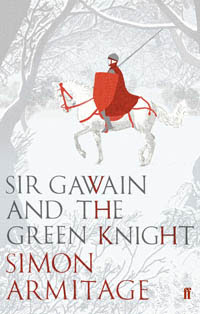
'Tis but a Scratch!

Sir Gawain and the Green Knight
Simon Armitage
Faber and Faber

When I was an undergrad, my worst mark ever was the B+ I received in Middle English from Dr. Weldon. While I hated the professor and his pedantic approach to the texts, I loved the course material and would spend hours reading off the syllabus. I have to admit to not being a huge fan of poetry, but there is just something about verse from the Middle Ages that captures my imagination.

Sir Gawain and the Green Knight was written around 1400. Not a lot is known about the poet and the poem itself is noteworthy in that it draws on the Old English tradition of alliteration. For those of you, um, unpoetical types, alliteration is the repetition of a particular consonant sound or leading vowel in a phrase. It sounds easy, I know, but to do it in such a way that it adds to rather than distracts from a text is quite a talent -- and the Gawain poet does it with such style.

This particular edition of the poem is a new translation by Simon Armitage. He maintains the alliteration and in my opinion, does a fantastic job with the verse. The plot is pretty simple -- a bunch of knights are hanging out with Arthur and Guinevere over the Christmas break. Suddenly, the door to the hall bursts open and in tromps a very large man all dressed in green. He issues a challenge and invites one of Arthur's company to fell him with a blow -- the caveat being that should the Green Knight live, the knight must seek him out a year hence and agree to the same terms. Gawain takes up the challenge, fails to kill the green knight (who, in fact, picks up his severed head, tucks it under his arm and rides off) and then, a year later, sets out on his own quest. Talk about a party trick! Armitage's translation gets 5 green girdles out of 5.

Wednesday, December 19, 2007

And the Nominees Are ...

So, it's not like the D-E-S has been deluged with requests or anything, but a few of you written to ask about this year's candidates for best book. It's a tough one ... I ended up reading a lot of really good stuff this year and picking just one is going to take some serious thought.

In fact, it might be easier to come up with some exclusion criteria. Romances are not eligible by virtue of the fact that they are absolute crap and essentially the same book regardless of sub-genre, historical period, or setting.

Non-fiction books, while impressive and impactful, are not eligible. Maybe someday I will get motivated enough to set up another category for a non-fiction winner. But not today.

Any post where I made mention of Bruce Campbell -- those books aren't eligible either. Don't get me wrong, I love Bruce. But he's not serious and high-minded -- not at all what we are looking for in a D-E-S book of the year.

So, after all that, the nominees are:

Three Day Road Joseph Boyden
Arthur & George Julian Barnes
The Road Cormac McCarthy
This Blinding Absence of Light Tahar Ben Jelloun
The Traveler John Twelve Hawks