Monday, January 04, 2010


Strange Meeting

The Cellist of Sarajevo
Steven Galloway
Knopf Canada

Reading this book made me very sad.  One day, during the siege of Sarajevo, a mortar shell lands in a market and kills twenty two people.  A cellist, who witnesses this tragedy from his upstairs window, mourns the city's loss by playing Albinoni's Adagio in G Minor every day for twenty two days in the middle of the street.    His performance is heard by everyone including Arrow, the sniper who is sent to protect him, Dragan, the baker, who dodges bullets on his way to work, and Kenan, the father who risks his life to get water for his family and neighbours.  

The novel, which weaves the narratives of each of these characters into a gritty and gripping tale of war, reminds the reader about the power of art. People come from all over the city  to hear the cellist play and in his music they hear beauty, hope and humanity. Contrast this with the hopelessness and nameless of the war.  Notably, the author avoids using "descriptive" terms such as Bosnian, Serb or even Muslim.  It's just the "us" of the city's inhabitants against the "them" of the hills.  The cellist is positioned as one of "us" and the enemy sniper, who is sent to kill him, is one of "them."  The sniper blurs the line, however, when he fails to make the hit and instead closes his eyes to soak up the beauty of the music.  Arrow kills him anyway.  War is so awful. 

Suffice it to say that while I found this to be a difficult read (and by "difficult" I mean emotional) it is definitely Wilfred Owen worthy.  Four achingly beautiful adagios out of five.

Saturday, January 02, 2010


Tall, Dark and Handsome

Sandstorm
James Rollins
HarperCollins

I've got a new boyfriend -- his name is Painter Crowe and he works for some US governmental special forces agency (DARPA).  He's a lean, mean fighting machine, speaks a whole bunch of languages, and best of all, is a total brainiac.  My boy holds a doctorate.  I know ... how did I ever find such a paragon?

Well, to be honest, my dad introduced us.  He met Painter earlier in the year and raved about him.  Unfortunately, I was a little distracted with my friend John Rebus -- you know, the guy with the commitment issues?  Anyway, Painter and I met up shortly before New Year's Eve and for me, it was love at first sight.  We didn't have much time -- he jetted off the to UK to investigate some mysterious explosion at the British Museum and now I understand he's somewhere in the Middle East.  Oman, I think.  Anyway, I hope to hear from him when he gets home.  I know, I know -- I have to stop dating international men of mystery -- it's almost becoming routine.  Our night out, however, was pretty exciting and he was such a good kisser.  At least 3.5 out of five.  I let you know when/if we happen to hook up again.

Monday, December 28, 2009

Three Cheers for the Gruesomes ...

Would it surprise you to learn that I had a very difficult time justifying my pick for the D-E-S book of the year?  It's true.   Pride and Prejudice and Zombies was not the "best" book that I had read all year.  It wasn't the funniest, the most touching, nor was it the most thought provoking.  It was, however, the most entertaining and as such, worked its way to the top of my gift list. 

That said, as good as Pride and Prejudice and Zombies was, it was not the only book that I shared with my friends.  For the boys in my life, I chose Andrew Davidson's The Gargoyle.  Narrated by a drug-addled narcissist , The Gargoyle is a "male" version of The Time Traveler's Wife.  It is a love story that transcends time and place and takes the reader through the depths of hell in a way that will remind you of Dante.  In short, it is a good tale and I would highly recommend it for a wintry afternoon.

Happy reading!  I wish you and your loved ones all the best for a joyful and prosperous 2010.  May your inner light guide your way.

Sunday, December 27, 2009


Renaissance Men

The Book of Unholy Mischief
Elle Newmark
Atria Books

It would seem that I am in a bit of a rut.  It might be payback for all the fantastic books that I read earlier in the year, but my last few selections have left me a little underwhelmed.  Then again, maybe it's not the books -- I've been trying to re-connect with my inner Pollyanna and the glad game has proven to be a bit of a challenge.  Could it be that I'm not in the mood to read these days?  Hmmm ...

So, The Book of Unholy Mischief is sort of like a 15th century DaVinci Code.  The hero of the narrative is Luciano -- a street urchin turned kitchen boy who comes to be a chef's apprentice in the kitchen of the Venetian doge.   At the centre of the novel are the Gnostic Gospels -- a series of books that are wanted by powerful men for a variety of reasons.  The Church wants them so they can maintain their power and combat the idea of the "god within."  Other people believe the books hold the secrets of alchemy and eternal life.  Luciano's maestro is one of the guardians of this knowledge and, well, you can predict the rest.

On the upside, the author did provide the reader with some rich descriptions of early renaissance Venice.  Now if only there had been a more imaginative plot...  One bud of garlic out of five.

Sunday, December 13, 2009


Is that you, Obi-Wan?

Long Way Round
Ewan McGregor and Charley Boorman
Sphere

Well, let me start out by saying that I think our friend Ewan should probably stick to acting.  Writing, as evidenced by this travelogue, is definitely not his forte.  If you were to ask me for three adjectives that best describe this work, I'd probably pick "insipid," "navel-gazing," and "poorly-written."  So much for international bestseller.

For those of you who don't know the back story, a few years ago, Ewan McGregor and a fellow motorcycle-nut, Charley Boorman, decided that they would like to take the trip of a lifetime and bike their way from London to New York.  They were going to take the "long way round" by crossing Europe, into Kazakhstan, across Mongolia, and eventually through Siberia where they would then catch a plane to Alaska and cross North America to New York.  The journey took about three and a half months and their adventures were documented by both themselves and by a film crew for reality-type series. 

The book alternates between narrators and I think that is part of the reason why I didn't really enjoy it.  While I've never ridden across a continent on a motorcycle, I have done my fair share of  road tripping and I understand what it is like to be cooped up with the same person (or people) for days on end.  At one point in the story, McGregor mentions that the experience was sometimes isolating -- they were on the same journey, but not doing it together.  That's how I felt about the book -- they were writing about the same series of events, but they weren't narrating the same story. One muddy pannier out of five.
We are time's subjects, and time bids be gone

Wow -- why does it seem that every year goes by faster and faster?  I'd like to think that there is some super-cool scientific explanation, but if one exists, I couldn't find it.  Part of me understands that it is just a matter of perception, but if time is whizzing past now, what will it be like when I'm older?  Ugh ... I can't even bear to think of it. 

So, back to the the purpose of this week's entry.  It is with great pleasure that I introduce the nominees for the D-E-S Book of the Year.  Once again, it's a bit of a mixed bag.  I tried to expand my reading boundaries this year and the book list reflects those choices.  Quite frankly, any of the selections is a more than decent read and more than one has made it to the distribution list in terms of this year's gifts.

And the nominees are:

Pride and Prejudice and Zombies, Jane Austen and Seth Grahame-Smith
The Elegance of the Hedgehog, Muriel Barbery
The Moonstone, Wilkie Collins
The Gargoyle, Andrew Davidson

Sarah's Key, Tatiana de Rosnay
Middlemarch, George Eliot
Anathem, Neal Stephenson

Thursday, December 10, 2009

I Know You Are, But What am I?

The Know-it-All
A.J. Jacobs
Simon and Schuster

Part memoir, part compendium of obscure and admittedly, often interesting fact, The Know-it-All is the written record of A.J. Jacobs' journey through the Encyclopaedia Britannica.  Yep, that's right kids  -- the man read the whole damn thing.   In his "spare" time.   Um, yeah.  And you people thought I was nerdy.

I'm not going to lie to you.  I actually enjoyed this book a great deal.  Jacobs managed to find a good balance between presenting some of the quirkier bits of the EB and sharing some of the quirkier bits of his private life.  Over the course of the year that it took him to finish this immense task, Jacobs and his wife were also trying to get pregnant.  I hardly think that a thirty-two tome oeuvre was always the best aphrodisiac, but he was sure able to educate his wife on the testicle size of elephants and the sexual habits of the bandicoot.  The poor woman.

While there are parts of this book that are only skim worthy, if you like words, puzzles, trivia and history, The Know-it-All is a fine read.  I  definitely admire Jacobs' determination -- I'm not sure that I could have finished.  Three pairs of reading glasses out of five.

Sunday, November 29, 2009


That Girl!

The Girl Who Played with Fire
Stieg Larsson
Quercus

Much has been made of Larsson's Millennium series and it got me to thinking ... is The Girl Who Played with Fire really part of a trilogy, or had the author lived, is it the second instalment in a much bigger series?  TGWPWF doesn't really exhibit the standard "book two" characteristics -- there isn't the expected lull in the action, a large number of new characters are introduced, and foreshadowing for events outside of the novel is almost completely absent.  In fact, I would argue that the lack of a story arc from Larsson's first novel to this one categorically excludes it from trilogy eligibility.  But what the hell do I know?  I just read this shit.

TGWPWF was, for me, a better read than The Girl with the Dragon Tattoo.  Wild-child and hacker extraordinaire, Lisbeth Salander, is in a whole heap of trouble.  Wanted by the Swedish police for the murders of three people, Salander goes into hiding unitl she can figure out a way to dispense of her troubles.  Helping her, of course, is the intrepid Mikael Blomqvist -- her former lover, editor of an investigative news magazine and one of her only friends.  There are more plot twists in this novel than a pretzel has bends.  Larsson could have wrapped up a bit sooner, but generally, it was a good read.  It makes me a little sad that Lisbeth Salander has only one book left.  She's one of the more interesting characters that I've read in awhile and definitely series worthy material.  Three scandalous body piercings out of five.

Sunday, November 22, 2009


I'm Swede on You

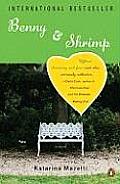
Benny and Shrimp
Katarina Mazetti
Penguin


I'm not usually prone to words like "heartwarming" and "charming," yet I can't think of anything better to describe this novel.  Benny and Shrimp are an unlikely pair that meet on a bench in a cemetery.  Benny is "visiting" with his mother and Shrimp (whose real name is Desiree) is contemplating the grave of her recently deceased husband.  One day, the couple exchange smiles and it is as if Cupid has sent arrows straight into their hearts.  That's the good news.  The bad news is that despite their obvious passion, they really aren't that compatible.

Benny is a farmer on the outskirts of town.  His life is tied to the rhythm of his cows and he is looking for a traditional Swedish helpmate -- someone who can help him fix the tractor, warm his bed, and make fantastic meatballs.  Shrimp, on the other hand, lives a more cerebral life.  She likes abstract art, thoughtful discussions about Lacan, and is the head of the children's section at the local library.  They are both in their late thirties and not expecting to be seized by love.  But they are and it surprising and funny and beautiful.

I'm not going to tell you how this story turns out.  It's actually worth the read.  Leaf fans be on the lookout for a reference to our team -- I think the author might have had a crush on Sundin.  Three quirky moo cows out of five.

Sunday, November 08, 2009

French Twist

Sarah's Key
Tatiana de Rosnay
St. Martin's Press

I've been putting off writing this entry for almost a week now. While I readily admit to innumerable flaws, procrastination usually isn't one of them and I've been giving some serious thought as to why the content for this post has been so elusive.

Let me start by saying that I really, really got absorbed by this story. I started it last Saturday night when I grabbed it off the shelf and stuffed it in my purse. I was heading out to my local Chinese buffet and, like always, wanted a book to act as my companion. As I opened the cover, I was immediately transported to Paris. It is 1942 and I am witness to a Jewish family being roused from their beds, torn from their apartment in Le Marais, and marched to Vel d'Hiv. Led by the French police, it was one of the worst round ups of the war. The families were first sent to internment camps outside of Paris and then to Auschwitz. Very few survived.

I turn the page to start the next chapter and I'm suddenly in present day Paris, in the same apartment in Le Marais, watching a modern French family discuss the renovations they will make to their grandmother's home now that she has moved to a care facility. As the story progresses, the mother, an American who is never quite accepted by her French relatives, starts to dig into the building's "history" and learns that her in-laws took possession of the rooms in late July 1942. The chapters alternate between heroines -- a little Jewish girl and an American in Paris -- and I am lost. I finished the book on Sunday and am thinking of it still. Sarah's Key gets five stars. Please read it.

Saturday, November 07, 2009

Paranormal Activity?

Born of Fire
Sherrilyn Kenyon
St. Martin's Press

Question: When is a bad vampire romance novel not a bad vampire romance novel? Answer: When it is a bad "paranormal" romance novel. Okay, I admit it ... I made slight error in judgement when I picked this one off the shelf. All I can say in my defense is that I was lured into thinking that I might actually enjoy it when I read the words "alternate universe," illicit scandal," and "assassin." The main character's name was "Syn" for goodness sake -- how could I go wrong?

To be fair to the novel, there were parts that I enjoyed (and no, I'm not talking about the sex scenes.) There was a "character" in the book named Vik, who was a robot wicked sense of humour. The fact that a robot could have wicked sense of humour really intrigued me and I very much liked this instance of Kenyon's imagination. The storyline was also relatively interesting and had the novel been better written, I think it could have been quite something. One fizzling blaster out of five.

Tuesday, November 03, 2009

Moving, Harrowing, Insightful and all that Other Stuff

What They Wanted
Donna Morrissey
Penguin Canada

The bulk of my day today was spent in waiting rooms. Last week's craziness left me a little under the weather and I ended up heading to my local clinic to see if I could get something to shake a nasty bug. Stuck in a room full of wailing children, disgruntled immunization candidates, and more sniffles that you could shake a stick at, I decided to block out the world by getting into a good book. Already in a contemplative mood, I was ready for harrowing, insightful and moving. And boy -- did I get it.

Morrissey's novel was gut wrenching. Spanning the course of twenty years, it tells the story of a Newfoundland family that is literally and figuratively pulled from the sea. The story opens with the ruin of the fisheries and the patriarch of the family having to leave the sea and take up residence (and occupation) on the land. A generation later, his daughter and son take it one step further and leave Newfoundland to work the oil fields of Alberta. They are as much in search of themselves as they are in search of a livelihood.

There was so much feeling poured into the writing of this novel that it is no wonder that I was overwhelmed when I first picked it up. I definitely want to know what happens to this family -- I can only hope that Morrissey writes more. Four intractable clouds out of five.

Monday, November 02, 2009

Back Stories

My Horizontal Life -- A Collection of One Night Stands
Chelsea Handler
Bloomsbury

Life has been rather hectic lately and lots has been going both personally and professionally. Last week found me on a bit of a road trip and as always, I brought along a good book for the journey. "Good" in this particular case, was a novel by Donna Morrissey -- a Newfoundland author whose writing is described as moving, harrowing, gripping and insightful. Well, I got about fifty pages in, started to cry and decided that maybe I wasn't quite in the mood for moving, harrowing, gripping and insightful. Luckily, one of my coworkers rescued me and gave me something else to read. It couldn't have been more different!

My Horizontal Life is about as shallow and uncomplicated as they come. The author, Chelsea Handler, is a stand-up comedian known for her love of the drink, her sense of adventure, and her slightly slutty ways. The book is a series of vignettes about the ups and downs of being a party-seeking twenty something who has very little responsibility and a very, uh, interesting relationship with her family. There were definitely some laugh out loud moments in this memoir and its fluffiness was exactly what I needed to lighten my mood. Two moderately dirty martinis out of five.

Wednesday, October 21, 2009

The Mystery Project

Cover Her Face
P.D. James
Randomhouse

Have you ever wondered what makes a novel a "classic"? I suppose it wouldn't surprise anyone to learn that I think about that particular question a great deal. And I'm not alone. Most of the major publishers have some kind of "best of" product line and a quick search of "classic literature" on the Internet returns thousands of hits. While I could easily find scads of "must reads," I had a much more challenging time unearthing a list of standard criteria that qualifies a novel as a classic. So, faithful readers, I have decided to ask you. In your opinion, what are the characteristics of a classic novel and why. In a future post, I'll consolidate the feedback and report back to you on what everyone has to say. Who knows, maybe we will end up with a publishable DES book list.

As for this week's selection, Cover Her Face, by British author P.D. James, would, I think, qualify as a classic. Written in 1964, the novel tells the story of Sally Jupp -- an unwed mother, social climber, and frankly, a bit of a schemer. Sally, a parlourmaid, is found murdered in her room the morning after she announces her engagement to the son of her employer. Everyone has a motive and it is left up to the famed Inspector Dalgliesh to puzzle it all out.

This book kept me guessing until the very end. Well-written and surprisingly contemporary, James' writing is spare, precise, and very engaging. Three watching the detectives out of five.

Thursday, October 08, 2009

One of my Better Blonde Moments


The Gargoyle
Andrew Davidson
Vintage Canada


A few weeks ago, I made a quick trip over to Port Huron to hang out with my best girl, Amy. It was a perfect day -- the weather was gorgeous, the drive was uneventful, and I got there early enough to check out a Target and buy a couple of books.

It was The Gargoyle's cover art that drew me in -- at first glance, it looked like it had been burnt in a fire and I picked it up to take a closer look. Upon reading the publisher's blurb, I discovered that the novel was about a man's descent into hell, his battle with his addictions, and the relationship he develops with a psych patient who is convinced that they were married in the fourteenth century. It sounded like a bit of a mixed bag -- but interesting -- so I thought I would give it a whirl. When I got home, I stuck The Gargoyle on my TBR shelf and didn't give it a second thought.

Flash forward a few weeks. The DES is at the drugstore buying Nyquil for a wicked cold and found herself in the book section. On the shelf is a novel with beautiful cover art of a girl with a pair of wings tattooed on her back. A sacred heart is emblazoned in the middle of the cover and I was so struck with it's beauty that I decided I had to read it. Yeah -- it was the Gargoyle. Same book, different cover. Sigh. Sometimes I'm not so smart.

Happily, it turned out to be a fantastic read and well worth the extra copy. In fact, I think it just might be in the running for the D-E-S book of the year. It was that good. Four smiling grotesques out of five.

Tuesday, September 29, 2009

The Art of War

The Savage Detectives
Roberto Bolaño
Picador

For almost a month now, I have been reading the same book -- Roberto Bolaño's The Savage Detectives. You would think that after having spent so much time with this novel, I'd have something interesting to say. Well, while I hate to disappoint, I'm afraid that this one is beyond me. Believe it or not, I actually had an easier time reading Joyce's Ulysses.

From a "plot" perspective, the story is about two Latin American poets hanging out in Mexico (and elsewhere around the world) during the mid to late seventies. Both men seem to be in pursuit of some intellectual ideal and are trying to establish a poetic movement called "visceral realism". Ulises Lima and Arturo Belano, the somewhat absent main characters, are inexplicably charismatic and are a constant jumble of writings, thoughts and big ideas.

In some ways, I think this novel was brilliant. There were at least twenty narrators who collectively manage to tell the "story". The middle section of the books is a series of interviews with characters who talk about Ulises and Arturo -- you never actually hear from them directly. The first and third sections of the book are narrated by a slightly naive, very ardent law student turned poet, Juan Garcia Madero. He is so passionate, so utterly exploding with emotion that it made the novel, in parts, a joy to read. Three decadent libertines out of five.

Saturday, September 05, 2009

MizUnderstood

Emma's Table
Philip Galanes
Harper

Imagine my revulsion when, a few pages into the novel, I realized that the author had ripped the "heroine" right out of the headlines. Emma Sutton is a sixty something convicted felon who, having done her time for tax evasion, is trying to get her groove back. The face (although no longer head) of her home design empire, Emma's got a regular spot on Oprah, a line of housewares at Target, and a beautifully decorated apartment with a spectacular view of Central Park. Um, yeah. I must have been having a serious blonde moment when I pulled this one from the table. I mean, really -- do I seem like a Martha Stewart girl to you?

Much to my surprise, this book is actually a winner. While a good portion of the narrative directly relates to Emma and her realization that she needs to change, there are a number of subplots that involve other characters that are equally engaging. By the end of the novel, Galanes masterfully combines all of the storylines into a single climactic scene and contrary to my expectation, not everything gets wrapped up like a parcel under a tree. Galanes characters are all flawed in some way, but every single one of them also has some redemptive qualities that manage to shine through their frailties. At the end of the day, this book was a heart-warming read and not nearly as saccharine as the cover implies. Three frosted cupcakes out of five.

Sunday, August 30, 2009

Single Schmingle

How to be Single
Liz Tuccillo
Washington Square Press

So the best thing that I can say about this book is that the cover art let me use purple font as part of this post. Um, yeah. It was that bad.

How to be Single is about a late thirty-something New Yorker, Julie, who decides she's tired of being asked why she is single. She's sexy, and pretty, and has a big-brain and a great job, and the people in her life (excluding her other single girlfriends) can't understand why she can't find a man. Frustrated, Julie buys an around the world ticket and sets off on a trans-global adventure to find out how women in other cultures can be single, happy, and fulfilled.

Julie first goes to France where she learns that a woman must have, above all else, pride. She then goes to Italy. I'm not really clear what she learned there, but she spent a lot of time being wooed by a Frenchman who had followed her from Paris. In Australia she learns that she must love herself. In Bali, she learns to fall in love (with the married Frenchman whose apparently not-so-proud wife hauls her pregant self around the world to bring him back.) In China, Julie learns that the grass is always greener on the other side; Asian men want Western women and Asian girls want Western guys. She also goes to Brazil, to Iceland and then home to America. You get the idea. Once back in the land of the brave, home of the free, Julie decides that relationships just happen and maybe, just maybe, there's a miracle out there for her. Oh barf. One Jimmy Choo out of five.
It is the nature of truth to struggle to the light
The Moonstone
Wilkie Collins
Penguin Canada

It took me almost four weeks to make it through this novel. Not because it was too long or too boring -- but because it was too good. When I first started the book, I decided to play along to see if I could figure out the "whodunit." Maybe I'm not too smart, or maybe Collins' is just a fantastic writer because this story kept me guessing until the very end.

Considered by some to be the first example of detective fiction in the English language, The Moonstone is a story about a famous yellow diamond that is said to carry a terrible Indian curse. Collins uses multiple narrators (all of whom are wholly unreliable) to spin the tale and he introduces his readers to the various types that are now standard in early mystery novels -- the bungling local policeman, the savvy gentleman amateur investigator, the mythic professional from Scotland Yard, the manor house as scene-of-the-crime, a plethora of suspects and the infamous red herring.

From a social perspective, the novel also had a lot to offer. Collins was quite liberal for his day and he had very forward-thinking views on class, race, and religion. His characterization of Miss Clack (a poor relation to one of the main characters and a tract-distributing zealot) had me in stitches. The novel was choc-a-bloc full of humour and pathos and probably should have been included on my Victorian lit syllabus when I was studying at university. Oh -- so many books, so little time. Three and one half candles in the drawing room with Professor Plum.

Saturday, August 08, 2009

Incredible Hulks

Rapscallion
James McGee
Harper Collins

One of the last "conventional" books that I bought for my dad before he passed away was McGee's Rapscallion. For those of you who have been with me for awhile, you will recognize the author from an earlier post when I reviewed The Resurrectionist. I'll be honest ... the writing hasn't really improved and the characters are no further developed. That's the bad news. The good news is that Rapscallion had both an interesting plot and enough of an historical bent to keep me engaged. I daresay I actually learned something.

Did you know, for example, that during the Napoleonic wars, Britain used hulks (ships that are afloat, but incapable of going to sea) moored on the Thames as prisons? It's true! The living conditions on these ships were abominable and it was not uncommon for the mortality rate aboard the vessels to hover around 30%. It is said that on a warm day, the smell coming off of these ships was enough to pollute the air from bank to bank. Gross.

Unfortunately, while mildly entertaining and somewhat educational, Rapscallion was unable to distract me from missing my dad. In fact, I think it made me miss him more. In the last couple of weeks before he died, we had started to read this one together. It had been a long time since I had read aloud to anyone and we had only gotten a few chapters in before it became too much of an effort for him. Sigh. This one gets one sad and lonely star out of five.