Sunday, November 29, 2009
The Girl Who Played with Fire
Stieg Larsson
Quercus
Much has been made of Larsson's Millennium series and it got me to thinking ... is The Girl Who Played with Fire really part of a trilogy, or had the author lived, is it the second instalment in a much bigger series? TGWPWF doesn't really exhibit the standard "book two" characteristics -- there isn't the expected lull in the action, a large number of new characters are introduced, and foreshadowing for events outside of the novel is almost completely absent. In fact, I would argue that the lack of a story arc from Larsson's first novel to this one categorically excludes it from trilogy eligibility. But what the hell do I know? I just read this shit.
TGWPWF was, for me, a better read than The Girl with the Dragon Tattoo. Wild-child and hacker extraordinaire, Lisbeth Salander, is in a whole heap of trouble. Wanted by the Swedish police for the murders of three people, Salander goes into hiding unitl she can figure out a way to dispense of her troubles. Helping her, of course, is the intrepid Mikael Blomqvist -- her former lover, editor of an investigative news magazine and one of her only friends. There are more plot twists in this novel than a pretzel has bends. Larsson could have wrapped up a bit sooner, but generally, it was a good read. It makes me a little sad that Lisbeth Salander has only one book left. She's one of the more interesting characters that I've read in awhile and definitely series worthy material. Three scandalous body piercings out of five.
Sunday, November 22, 2009
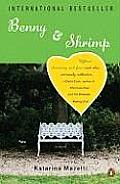
Benny and Shrimp
I'm not usually prone to words like "heartwarming" and "charming," yet I can't think of anything better to describe this novel. Benny and Shrimp are an unlikely pair that meet on a bench in a cemetery. Benny is "visiting" with his mother and Shrimp (whose real name is Desiree) is contemplating the grave of her recently deceased husband. One day, the couple exchange smiles and it is as if Cupid has sent arrows straight into their hearts. That's the good news. The bad news is that despite their obvious passion, they really aren't that compatible.
Benny is a farmer on the outskirts of town. His life is tied to the rhythm of his cows and he is looking for a traditional Swedish helpmate -- someone who can help him fix the tractor, warm his bed, and make fantastic meatballs. Shrimp, on the other hand, lives a more cerebral life. She likes abstract art, thoughtful discussions about Lacan, and is the head of the children's section at the local library. They are both in their late thirties and not expecting to be seized by love. But they are and it surprising and funny and beautiful.
I'm not going to tell you how this story turns out. It's actually worth the read. Leaf fans be on the lookout for a reference to our team -- I think the author might have had a crush on Sundin. Three quirky moo cows out of five.
Sunday, November 08, 2009
French TwistI've been putting off writing this entry for almost a week now. While I readily admit to innumerable flaws, procrastination usually isn't one of them and I've been giving some serious thought as to why the content for this post has been so elusive.
Let me start by saying that I really, really got absorbed by this story. I started it last Saturday night when I grabbed it off the shelf and stuffed it in my purse. I was heading out to my local Chinese buffet and, like always, wanted a book to act as my companion. As I opened the cover, I was immediately transported to Paris. It is 1942 and I am witness to a Jewish family being roused from their beds, torn from their apartment in Le Marais, and marched to Vel d'Hiv. Led by the French police, it was one of the worst round ups of the war. The families were first sent to internment camps outside of Paris and then to Auschwitz. Very few survived.
I turn the page to start the next chapter and I'm suddenly in present day Paris, in the same apartment in Le Marais, watching a modern French family discuss the renovations they will make to their grandmother's home now that she has moved to a care facility. As the story progresses, the mother, an American who is never quite accepted by her French relatives, starts to dig into the building's "history" and learns that her in-laws took possession of the rooms in late July 1942. The chapters alternate between heroines -- a little Jewish girl and an American in Paris -- and I am lost. I finished the book on Sunday and am thinking of it still. Sarah's Key gets five stars. Please read it.
Saturday, November 07, 2009
Paranormal Activity?Sherrilyn Kenyon
St. Martin's Press
Question: When is a bad vampire romance novel not a bad vampire romance novel? Answer: When it is a bad "paranormal" romance novel. Okay, I admit it ... I made slight error in judgement when I picked this one off the shelf. All I can say in my defense is that I was lured into thinking that I might actually enjoy it when I read the words "alternate universe," illicit scandal," and "assassin." The main character's name was "Syn" for goodness sake -- how could I go wrong?
To be fair to the novel, there were parts that I enjoyed (and no, I'm not talking about the sex scenes.) There was a "character" in the book named Vik, who was a robot wicked sense of humour. The fact that a robot could have wicked sense of humour really intrigued me and I very much liked this instance of Kenyon's imagination. The storyline was also relatively interesting and had the novel been better written, I think it could have been quite something. One fizzling blaster out of five.
Tuesday, November 03, 2009
Moving, Harrowing, Insightful and all that Other StuffWhat They Wanted
Donna Morrissey
Penguin Canada
The bulk of my day today was spent in waiting rooms. Last week's craziness left me a little under the weather and I ended up heading to my local clinic to see if I could get something to shake a nasty bug. Stuck in a room full of wailing children, disgruntled immunization candidates, and more sniffles that you could shake a stick at, I decided to block out the world by getting into a good book. Already in a contemplative mood, I was ready for harrowing, insightful and moving. And boy -- did I get it.
Morrissey's novel was gut wrenching. Spanning the course of twenty years, it tells the story of a Newfoundland family that is literally and figuratively pulled from the sea. The story opens with the ruin of the fisheries and the patriarch of the family having to leave the sea and take up residence (and occupation) on the land. A generation later, his daughter and son take it one step further and leave Newfoundland to work the oil fields of Alberta. They are as much in search of themselves as they are in search of a livelihood.
There was so much feeling poured into the writing of this novel that it is no wonder that I was overwhelmed when I first picked it up. I definitely want to know what happens to this family -- I can only hope that Morrissey writes more. Four intractable clouds out of five.
Monday, November 02, 2009
Back StoriesMy Horizontal Life is about as shallow and uncomplicated as they come. The author, Chelsea Handler, is a stand-up comedian known for her love of the drink, her sense of adventure, and her slightly slutty ways. The book is a series of vignettes about the ups and downs of being a party-seeking twenty something who has very little responsibility and a very, uh, interesting relationship with her family. There were definitely some laugh out loud moments in this memoir and its fluffiness was exactly what I needed to lighten my mood. Two moderately dirty martinis out of five.
Wednesday, October 21, 2009
The Mystery ProjectCover Her Face
P.D. James
Randomhouse
Have you ever wondered what makes a novel a "classic"? I suppose it wouldn't surprise anyone to learn that I think about that particular question a great deal. And I'm not alone. Most of the major publishers have some kind of "best of" product line and a quick search of "classic literature" on the Internet returns thousands of hits. While I could easily find scads of "must reads," I had a much more challenging time unearthing a list of standard criteria that qualifies a novel as a classic. So, faithful readers, I have decided to ask you. In your opinion, what are the characteristics of a classic novel and why. In a future post, I'll consolidate the feedback and report back to you on what everyone has to say. Who knows, maybe we will end up with a publishable DES book list.
As for this week's selection, Cover Her Face, by British author P.D. James, would, I think, qualify as a classic. Written in 1964, the novel tells the story of Sally Jupp -- an unwed mother, social climber, and frankly, a bit of a schemer. Sally, a parlourmaid, is found murdered in her room the morning after she announces her engagement to the son of her employer. Everyone has a motive and it is left up to the famed Inspector Dalgliesh to puzzle it all out.
This book kept me guessing until the very end. Well-written and surprisingly contemporary, James' writing is spare, precise, and very engaging. Three watching the detectives out of five.
Thursday, October 08, 2009
One of my Better Blonde MomentsThe Gargoyle
Andrew Davidson
Vintage Canada
A few weeks ago, I made a quick trip over to Port Huron to hang out with my best girl, Amy. It was a perfect day -- the weather was gorgeous, the drive was uneventful, and I got there early enough to check out a Target and buy a couple of books.
It was The Gargoyle's cover art that drew me in -- at first glance, it looked like it had been burnt in a fire and I picked it up to take a closer look. Upon reading the publisher's blurb, I discovered that the novel was about a man's descent into hell, his battle with his addictions, and the relationship he develops with a psych patient who is convinced that they were married in the fourteenth century. It sounded like a bit of a mixed bag -- but interesting -- so I thought I would give it a whirl. When I got home, I stuck The Gargoyle on my TBR shelf and didn't give it a second thought.
Flash forward a few weeks. The DES is at the drugstore buying Nyquil for a wicked cold and found herself in the book section. On the shelf is a novel with beautiful cover art of a girl with a pair of wings tattooed on her back. A sacred heart is emblazoned in the middle of the cover and I was so struck with it's beauty that I decided I had to read it. Yeah -- it was the Gargoyle. Same book, different cover. Sigh. Sometimes I'm not so smart.
Happily, it turned out to be a fantastic read and well worth the extra copy. In fact, I think it just might be in the running for the D-E-S book of the year. It was that good. Four smiling grotesques out of five.
Tuesday, September 29, 2009
The Art of WarThe Savage Detectives
Roberto Bolaño
Picador
For almost a month now, I have been reading the same book -- Roberto Bolaño's The Savage Detectives. You would think that after having spent so much time with this novel, I'd have something interesting to say. Well, while I hate to disappoint, I'm afraid that this one is beyond me. Believe it or not, I actually had an easier time reading Joyce's Ulysses.
From a "plot" perspective, the story is about two Latin American poets hanging out in Mexico (and elsewhere around the world) during the mid to late seventies. Both men seem to be in pursuit of some intellectual ideal and are trying to establish a poetic movement called "visceral realism". Ulises Lima and Arturo Belano, the somewhat absent main characters, are inexplicably charismatic and are a constant jumble of writings, thoughts and big ideas.
In some ways, I think this novel was brilliant. There were at least twenty narrators who collectively manage to tell the "story". The middle section of the books is a series of interviews with characters who talk about Ulises and Arturo -- you never actually hear from them directly. The first and third sections of the book are narrated by a slightly naive, very ardent law student turned poet, Juan Garcia Madero. He is so passionate, so utterly exploding with emotion that it made the novel, in parts, a joy to read. Three decadent libertines out of five.
Saturday, September 05, 2009
MizUnderstoodPhilip Galanes
Harper
Imagine my revulsion when, a few pages into the novel, I realized that the author had ripped the "heroine" right out of the headlines. Emma Sutton is a sixty something convicted felon who, having done her time for tax evasion, is trying to get her groove back. The face (although no longer head) of her home design empire, Emma's got a regular spot on Oprah, a line of housewares at Target, and a beautifully decorated apartment with a spectacular view of Central Park. Um, yeah. I must have been having a serious blonde moment when I pulled this one from the table. I mean, really -- do I seem like a Martha Stewart girl to you?
Much to my surprise, this book is actually a winner. While a good portion of the narrative directly relates to Emma and her realization that she needs to change, there are a number of subplots that involve other characters that are equally engaging. By the end of the novel, Galanes masterfully combines all of the storylines into a single climactic scene and contrary to my expectation, not everything gets wrapped up like a parcel under a tree. Galanes characters are all flawed in some way, but every single one of them also has some redemptive qualities that manage to shine through their frailties. At the end of the day, this book was a heart-warming read and not nearly as saccharine as the cover implies. Three frosted cupcakes out of five.
Sunday, August 30, 2009
Single SchmingleLiz Tuccillo
Washington Square Press
So the best thing that I can say about this book is that the cover art let me use purple font as part of this post. Um, yeah. It was that bad.
How to be Single is about a late thirty-something New Yorker, Julie, who decides she's tired of being asked why she is single. She's sexy, and pretty, and has a big-brain and a great job, and the people in her life (excluding her other single girlfriends) can't understand why she can't find a man. Frustrated, Julie buys an around the world ticket and sets off on a trans-global adventure to find out how women in other cultures can be single, happy, and fulfilled.
Julie first goes to France where she learns that a woman must have, above all else, pride. She then goes to Italy. I'm not really clear what she learned there, but she spent a lot of time being wooed by a Frenchman who had followed her from Paris. In Australia she learns that she must love herself. In Bali, she learns to fall in love (with the married Frenchman whose apparently not-so-proud wife hauls her pregant self around the world to bring him back.) In China, Julie learns that the grass is always greener on the other side; Asian men want Western women and Asian girls want Western guys. She also goes to Brazil, to Iceland and then home to America. You get the idea. Once back in the land of the brave, home of the free, Julie decides that relationships just happen and maybe, just maybe, there's a miracle out there for her. Oh barf. One Jimmy Choo out of five.
It is the nature of truth to struggle to the light Wilkie Collins
Penguin Canada
It took me almost four weeks to make it through this novel. Not because it was too long or too boring -- but because it was too good. When I first started the book, I decided to play along to see if I could figure out the "whodunit." Maybe I'm not too smart, or maybe Collins' is just a fantastic writer because this story kept me guessing until the very end.
Considered by some to be the first example of detective fiction in the English language, The Moonstone is a story about a famous yellow diamond that is said to carry a terrible Indian curse. Collins uses multiple narrators (all of whom are wholly unreliable) to spin the tale and he introduces his readers to the various types that are now standard in early mystery novels -- the bungling local policeman, the savvy gentleman amateur investigator, the mythic professional from Scotland Yard, the manor house as scene-of-the-crime, a plethora of suspects and the infamous red herring.
From a social perspective, the novel also had a lot to offer. Collins was quite liberal for his day and he had very forward-thinking views on class, race, and religion. His characterization of Miss Clack (a poor relation to one of the main characters and a tract-distributing zealot) had me in stitches. The novel was choc-a-bloc full of humour and pathos and probably should have been included on my Victorian lit syllabus when I was studying at university. Oh -- so many books, so little time. Three and one half candles in the drawing room with Professor Plum.
Saturday, August 08, 2009
Incredible HulksJames McGee
Harper Collins
One of the last "conventional" books that I bought for my dad before he passed away was McGee's Rapscallion. For those of you who have been with me for awhile, you will recognize the author from an earlier post when I reviewed The Resurrectionist. I'll be honest ... the writing hasn't really improved and the characters are no further developed. That's the bad news. The good news is that Rapscallion had both an interesting plot and enough of an historical bent to keep me engaged. I daresay I actually learned something.
Did you know, for example, that during the Napoleonic wars, Britain used hulks (ships that are afloat, but incapable of going to sea) moored on the Thames as prisons? It's true! The living conditions on these ships were abominable and it was not uncommon for the mortality rate aboard the vessels to hover around 30%. It is said that on a warm day, the smell coming off of these ships was enough to pollute the air from bank to bank. Gross.
Unfortunately, while mildly entertaining and somewhat educational, Rapscallion was unable to distract me from missing my dad. In fact, I think it made me miss him more. In the last couple of weeks before he died, we had started to read this one together. It had been a long time since I had read aloud to anyone and we had only gotten a few chapters in before it became too much of an effort for him. Sigh. This one gets one sad and lonely star out of five.
Thursday, August 06, 2009
Ooooh ... Candy! Sarah Addison Allen
Bantam
When I saw this book at the grocery store (yes, the grocery store!) I knew that I had to have it. I was getting ready to go up to my girlfriend's cottage for the weekend and I usually take at least a couple of books as, uh, well, cover. (It is so much easier being a little bit anti-social when you have a book to help you hide.) Anyway, as soon as I read the blurb on the back, I absolutely knew it was going to end up in my cart. Magic realism and a candy addicted, winter-loving heroine?! Whoa! How could I resist?
Josey is southern belle trapped in a bad situation. Her father, an incorrigible philanderer, passed away when she was nine and left her with a mother who didn't really love her. Bound by duty, Josey sticks it out at home yearning for an acceptance that she'll never receive. Her one joy (aside from the daily sightings of the gorgeously delicious mailman) is the secret stash of candy and travel magazines that she has hidden in her closet. One day, she's opens the door to access her cache and finds herself face-to-face with Della Lee -- a skankily beautiful, down-on-her-luck kind of girl who is a sometimes waitress, sometimes prostitute in the little town in which they both live. Della blackmails Josey into letting her stay and the story that develops out of this relationship becomes the basis for the entire novel.
Love, relationships, self-confidence, facing your fears, -- there isn't much that The Sugar Queen doesn't tackle and it is all handled with a dash of southern grace and charm. This novel is definitely a bildungsroman with a peppermint twist and I would encourage any fan of the "chick lit" genre to give it a whirl. Three tasty lemon drops out of five.
Tuesday, August 04, 2009
On the Road AgainRosamunde Pilcher
St. Martin's Press
Last Wednesday marked the first day of my "official" summer vacation. It was a bit of a rocky start -- my flight to Calgary got turned back over the Ontario/Manitoba border and the delay cost me my connection to Whitehorse. Six hours after my originally scheduled flight, I was put on a plane to Vancouver and eventually rolled into the Yukon a mere seven or so hours late. The downside to the ordeal was that I think I will soon be enrolling in some anger management classes. The upside was that it gave me the opportunity to read a couple of books.
The Shell Seekers is a lovely story set in the early to mid-eighties about a Englishwoman, Penelope Keeling, and her three grown children, Nancy, Olivia and Noel. The novel opens with Penelope returning to her home after a brief stint in the hospital following a heart attack. As most people do after a traumatic event, she takes stock of her life and reminisces over things past.
What I enjoyed most about this novel was how Pilcher uses beautiful language to paint vivid portraits of the main characters. Penelope and her children weren't always likeable, but they were so real that they could have stepped off the pages and sat down at my kitchen table for a cup of tea. Like most family chronologies, (think The Thornbirds) there was a lot of melodrama within the pages. There was also, however, enough of a story to keep me hooked and awake on a trans-Canada flight. Two point five stars out of five.
Sunday, July 19, 2009
You Don't Know Me Wm. Paul Young
Windblown Media
I was in Minneapolis a few weeks ago having dinner with colleagues and I asked them what they were reading. Both had recently finished The Shack and both mentioned that while the subject matter was quite heavy, they thought the novel to be very uplifting. At the time, I felt like I was in need of some uplifting, so when I got back to the airport, I sought out a copy.
What a mistake! For those of you who haven't heard of it, The Shack is the story of middle-aged man trying to understand how God could let his six year old daughter be abducted and murdered. To work through his anger and his grief, the man returns to the "shack" -- the last known place of his daughter's whereabouts -- to confront God and ask his questions. I probably should have stopped reading once I figured out that God was a black woman named Papa. I kid you not.
When I read the online reviews for this novel, it became evident that the story either really spoke to its audience, or it failed miserably. For me, it certainly didn't answer any questions about why evil exists or even why bad things happen to good people. Then again, maybe I didn't like it because of my "good" Lutheran upbringing. There are some serious doctrinal issues with this text that even I could spot. I think if I'm looking for clear messages about salvation and redemption, I'll stick with my Bible. One faded star out of five.
Wednesday, July 15, 2009
Who ... Me?I’ve been having a tough time trying to find the motivation to write this post. My dad died last week and things just don’t feel quite right. If I were a betting man, I’d say that I’m either going to be reading a tonne over the next few months, or not at all. Whether I will ever feel like writing again … well, that remains to be seen. I guess you will just have to check back every once in awhile to see if I’m still in the game.
So, while we’re here, let’s talk about this week’s book – The Girl with the Dragon Tattoo. I totally picked this novel because of the title (how could I not?) and I have to say that I was pretty impressed. While not exactly a thriller, this book was dark in a way that I totally didn’t expect. The basic plot is simple, but interesting – a forty-something journalist gets hired by a captain of industry to solve the 40 year-old mystery surrounding the disappearance/murder of his favourite niece. The journalist’s cover story is that he is writing a family biography and as such, needs access to everyone and everything related to the clan. The family is, of course, crazier than a troop of baboons and meaner than a pack of hungry jackals. The journalist’s crack researcher – the girl with the dragon tattoo – has a few issues of her own and when the two of them hook up, weird things start to happen.
Considering how crap things have been for me over the past couple of weeks, I’ve got to give Larsson his due. This book managed to both distract and entertain me. Larsson passed away a few years ago, but he actually produced a trilogy that involves both the journalist and the girl. I was intrigued enough by these characters to want to get to know them better. The Girl with the Dragon Tattoo gets three Swedish berries out of five.
Sunday, June 21, 2009
And I don't even like potatoes!The Guernsey Literary and Potato Peel Pie Society
Dial Press
Mary Ann Shaffer
Annie Barrows
To Juliet Ashton from DES, March 2nd, 1947
Dearest Juliet,
It was with great interest that I read the latest correspondence between you and the members of the Guernsey Literary and Potato Peel Pie Society. I have to say that when you told me you were packing up your flat in London to "investigate" the possibility of writing a book about the Guernsey Occupation, I thought you were a bit mad. We've all been so broken by the events of the last six years that I honestly felt you should just move on to other, less painful things. Your columns during the war were fantastic, of course, and just what we needed to lift our spirits. When you shared the islanders' letters with me, however, I can completely understand what has drawn you to that corner of the world. Their stories are just so poignant. I rush to the mailbox every day to see if you've sent me more letters. I'm hoping you do something lovely for these generous people.
Now, not to switch topics too abruptly, but I was speaking with a mutual friend the other day and he seems quite put out by the fact that you've forsaken him for a "bunch of farmers and old women". In fact, just the other day I saw that viper Beatrice Worthington hanging off his arm at the club. They were getting awfully close if you ask me. He's such a catch, Juliet, are you sure you know what you're doing? You haven't met someone else have you? Surely you'd tell me. You would tell me, wouldn't you?
I must dash. Charles and I are off to see a new play this evening and I have yet to find something to wear. I lost the better part of my wardrobe when our apartment block was bombed and I still haven't persuaded Charles to fund a new one. Sigh. Oh, apparently the show we're seeing is getting rave reviews -- five stars, I heard. I'll tell you more in my next missive.
All my love,
DES
Friday, June 19, 2009
L'Élégance du hérissonI don't know if I loved this book because it made me feel somewhat educated and slightly cultured, or because it made me feel entirely dull-witted and slow. I definitely had moments of both while reading this text and I am sorely pressed to say which captured me more.
Set in an elegant Parisian apartment, the novel intertwines the narratives of two of the building's residents -- Renée Michel, the building's dumpy, slow, and stereotypical French concierge, and Paloma Josse, a twelve-year old girl, whose understanding of the absurdities of life would put Ionesco to shame. Both characters go to great lengths to hide themselves from the outer world. Renée portrays herself as others expect her to be and she lives a clandestine life full of philosophy, music, art, culture and custom. Paloma hides by retreating into herself, rarely speaking, but keeping a journal of profound thoughts and movements. If I were still an academic, I think I would be tempted to construct a semester-long course around this novel. You could easily spend weeks discussing the ideas that each character presents.
What made this novel especially beautiful was the author's use and range of language. Even in translation, I was caught by Barbery's lush descriptions and gorgeous phrasing. She can find the rightness in quoting a lyric from Eminem as easily as she can find it in a passage from Tolstoy. The book was just so full of Beauty that I felt like I was breathing fresh air through my eyes. Five heartfelt sighs out of five.
Sunday, June 07, 2009
I Need Brains ... In a Good WayQuirk Books
Jane Austen and Seth Grahame-Smith
What do you get when you take a classic piece of English literature and add zombies, Shaolin-trained country misses, and the occasional honour-killing? Well, aside from the fact that it sounds like a perfect script for the next Bruce Campbell project, you get a fantastic read that makes you think about first impressions, class warfare (pun intended) and the topsy-turvy nature of relationships.
I loved this novel! I'm not exactly sure how Grahame-Smith managed to insert both zombies and ninjas into the text and still preserve that early Regency feel, but he did. His grotesque version of this story somehow enhances Austen's original work and his subtle addition of some off-colour humour about balls (um, of the dance variety) actually made me laugh out loud. Four decaying unmentionables out of five.